Seth on Simulink

April 1st, 2009

Spring 2009 MATLAB Contest: Data Visualization

The Spring MATLAB programming contest has just begun. This contest is different from contests in the past, so I recommend you start by reading the contest rules. This contest is less about algorithms and tweaking (although I'm sure that will happen), and more about visualizing an interesting data set. The data set for this contest is previous contest data! I took a crack at it and submitted my own visualization.

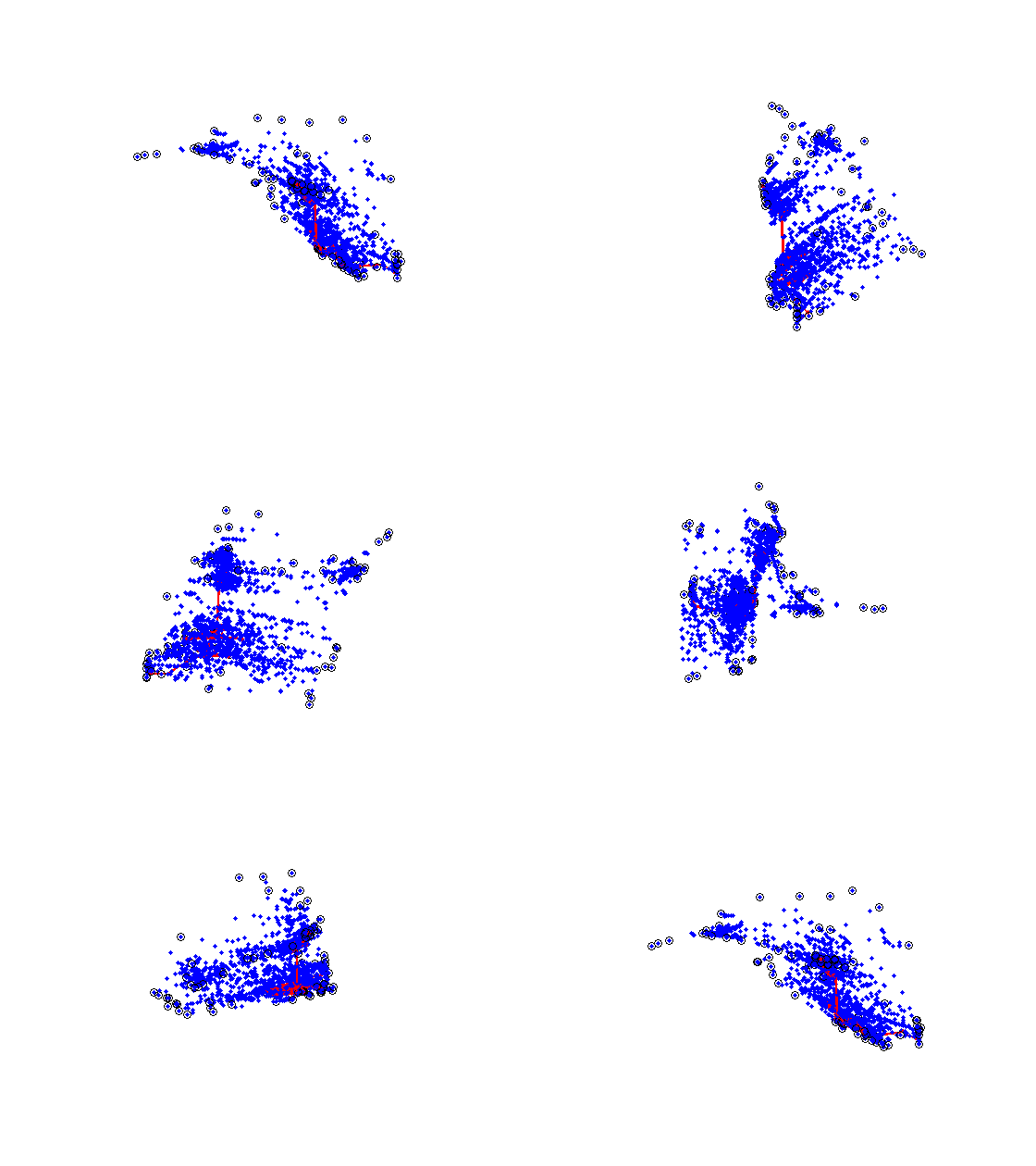
I wanted to look at the underlying space of two factors that went into the overall score for the contest, and see how they related to the length of the entry. The main factors that affect score are the result, complexity and the CPU time. I chose result, cpu_time and the nodeCount for my visualization. This is perfect for a 3-D scatter.

Here is the result of my visualization, animated to get the full 3-D effect.
Take a look at Doug's contest blog post for other ideas on how to visualize this data.

One Response to “Spring 2009 MATLAB Contest: Data Visualization”

  1. nassim replied on :

    Hi Seth
    I have some 3D points that are in the following form:
    [X,Y]=meshgrid(1:3,1:3);
    Z=rand(3).*ones(3);
    mesh(X,Y,Z)
    I want to create a virtual reality scene, where X and Y dimensions are kept the same, while Z is changing at each time step. How can I generate such a mesh that is dynamically changing with time in virtual reality?
    Note: All the simulations are carried in Simulink. Also the Z represents sea wave height.
    Thanks

Leave a Reply

Wrap code fragments inside <pre> tags, like this:

<pre class="code">
a = magic(3);
sum(a)
</pre>

If you have a "<" character in your code, either follow it with a space or replace it with "&lt;" (including the semicolon).


Seth Popinchalk is an Application Engineer for The MathWorks. He writes here about Simulink and other MathWorks tools used in Model-Based Design.
  • Mohamamd: Hi Suth, I try to simulate a load tap-changing transformer in simulink but its control part has to be...
  • Han Geerligs: Hello Guy, thanks for the clarificaton and link. However in the documentation I am missing the...
  • Guy: @Han, you probably already know, but I think it is good to share with everyone. To zoom in use the key...
  • Han Geerligs: Hi Seth, Once again I’d like to point out that my biggest accelerator is using mouse and keyboard...
  • XaL: Hi, thanks for the tips. As someone wrote in http://blogs.mathwor ks.com/seth/2009/03/ 13/new-%C2%A0rele...
  • Uba osy: Hi, in the introductory example for fuzzy logic toolbox it was noted that using non fuzzy means, you could...
  • Prashant: How can I have same example but instead AC(1 to 10V 50 or 60Hz) and DC(0.5 to 10 V) then adding AC+DC but...
  • adrian chavarro: Great tool, for educational and sicentific, simulation. I would like to know where can i place a...
  • Ashish Sadanandan: @wei, I was talking about the case where the compiler would perform the ‘model_Xdim...
  • wei: @Ashish, I agree with your observation on compiler optimization but fail to see why Han’s code would be...

These postings are the author's and don't necessarily represent the opinions of The MathWorks.