
From Embodied Reasoning to Reliable Robot Actions with MATLAB
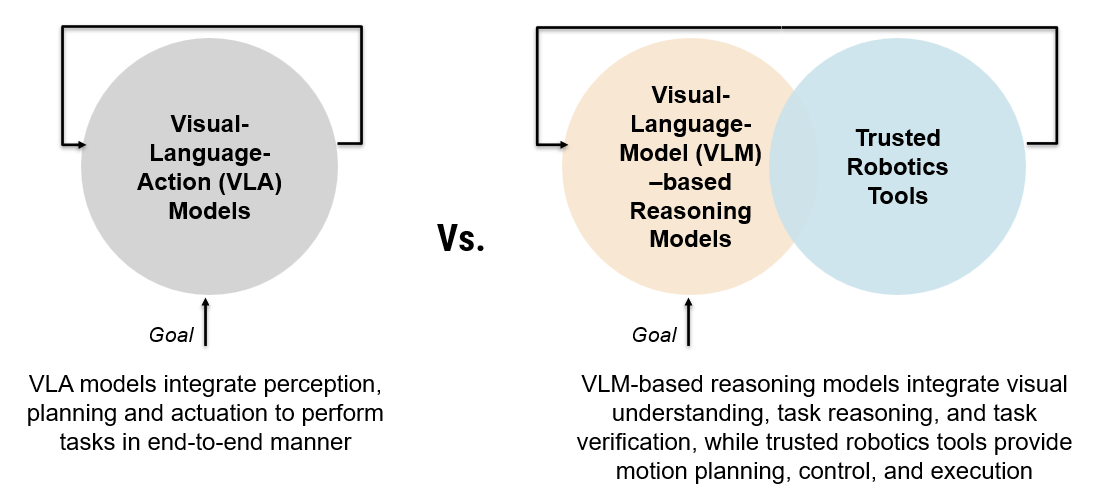
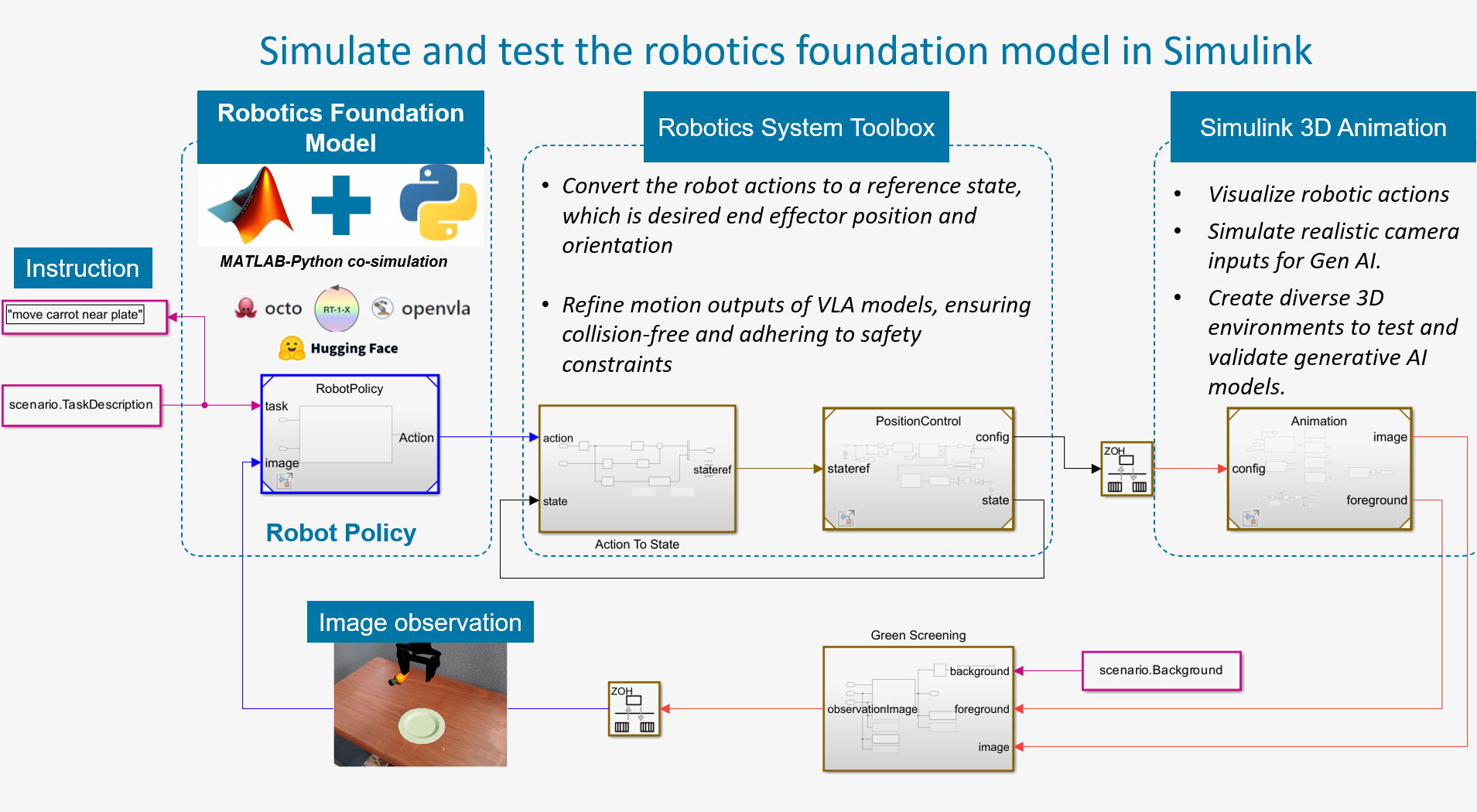
Last year, I wrote about the potential of vision-language-action, or VLA, models for robotics. These models can connect visual observations and natural-language instructions directly to robot actions, combining perception, planning, and action generation in an end-to-end learned system (VLA Blog).
That approach remains promising, particularly for adaptable and dexterous robot behavior. But what if a single VLA model can’t handle everything?
1 Combining External AI Reasoning with Trusted Robotics Engineering Tools
A complementary architecture is emerging: use vision-language model (VLM)-based embodied reasoning models for visual understanding, spatial reasoning, task planning, and task verification, while established robotics tools handle motion planning, control, simulation, and deployment.
Embodied AI reasons about what the robot should do. MATLAB and Simulink determine how the robot can do it reliably.
2 From End-to-End Action to Embodied Reasoning
Many embodied reasoning models build on VLM capabilities. A VLM connects visual observations with natural-language understanding. For robotics, embodied reasoning extends this capability to spatial reasoning, task decomposition, and task verification. Unlike a VLA model, however, a VLM-based reasoning model does not necessarily generate low-level robot actions.
Consider the instruction: “Move the elbow fittings to the table on the left.”
A VLM embodied reasoning model can analyze the instruction and camera observations to determine: Which objects are elbow fittings, Which surface is the left table, What order the objects should be moved, Where each object should be placed, and Whether the task was completed successfully.
Rather than generating every joint command directly, the model can produce task-level outputs such as object selections, pick-and-place targets, and completion criteria.
Robotics engineering tools can then translate those intentions into executable robot motion by performing: Coordinate transformations and inverse kinematics, Collision checking and motion planning, Trajectory generation and control, Simulation and system-level testing, and Robot connectivity and deployment.
This creates a useful separation of responsibilities.
- The VLM embodied reasoning model provides semantic and task-level intelligence.
- The robotics engineering tools provides geometric, kinematic, and execution-level intelligence.
3 A Closed-Loop Robotics Workflow
The architecture can be viewed as two connected layers.
The VLM embodied reasoning layer
An external model such as Gemini Robotics-ER or Nvidia Cosmos 3 interprets natural-language instructions and visual observations. It can identify task-relevant objects, understand spatial relationships, decompose the task, monitor progress, and determine whether the requested objective has been achieved.
This layer answers questions such as: What does the user want? Which objects are relevant? What is the appropriate task sequence? Has the task been completed correctly? Does the plan need to change?
The robotics execution layer
MATLAB, Simulink, and Robotics System Toolbox translate task-level intentions into feasible robot behavior.
This layer can perform: Robot and environment modeling, Coordinate-frame transformations, Forward and inverse kinematics, Collision checking, Manipulator motion planning, Trajectory generation, Joint and task-space control, Simulation and visualization, Connectivity to robot hardware, Code generation and deployment
This layer answers a different set of questions: Can the robot reach the requested object? Is the proposed grasp configuration valid? Does the motion avoid obstacles and self-collisions? Does it satisfy joint and workspace constraints? What trajectory should the robot follow? How should that trajectory be executed on the hardware?
The two layers operate together in a closed loop.
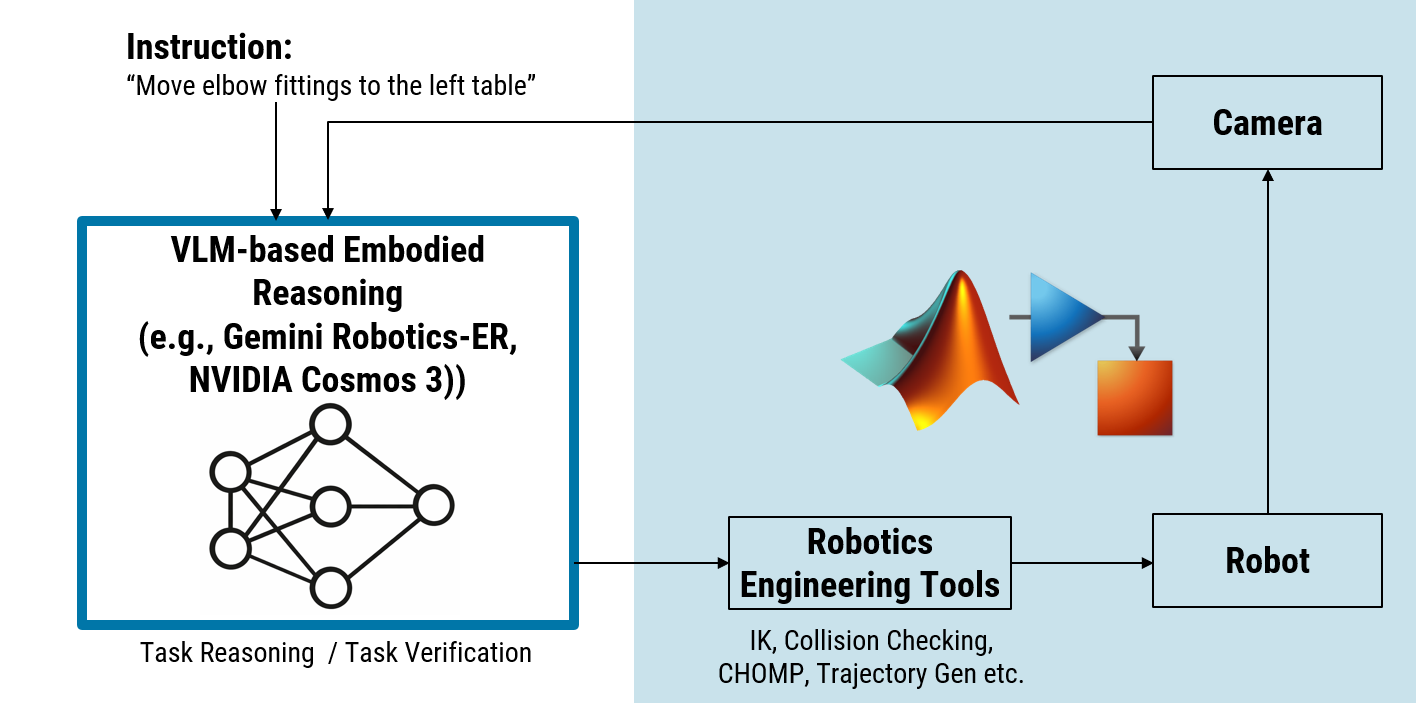
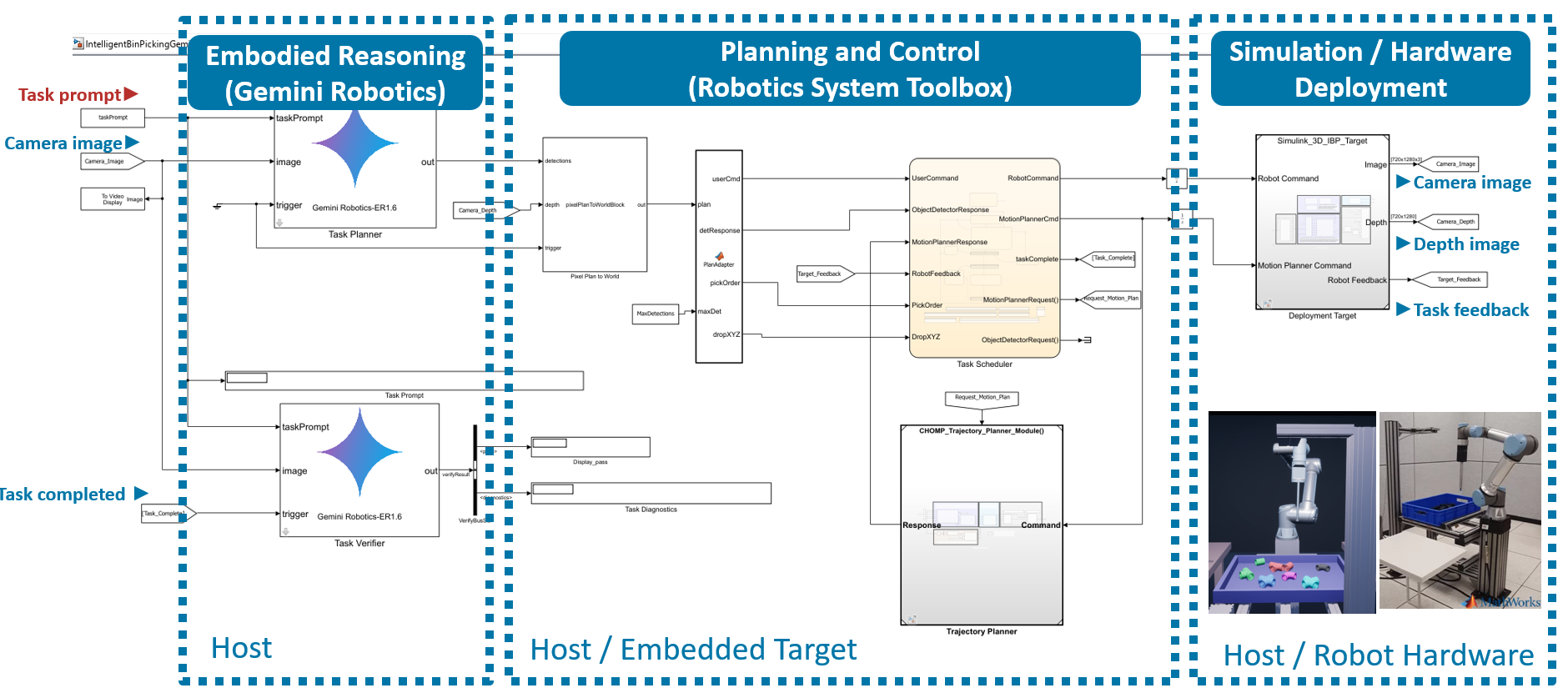
In the intelligent bin-picking example from the accompanying material, Gemini Robotics performs high-level reasoning and task verification. Robotics System Toolbox handles motion planning, inverse kinematics, and control. Simulink integrates the complete closed-loop workflow and supports both simulation and robot hardware.
4 Why Keep Planning and Control in Engineering Tools?
A VLM reasoning model may correctly identify that an elbow fitting belongs on the left table. But semantic correctness does not guarantee feasible robot motion.
The requested target could be: Outside the robot’s workspace, Near a joint limit, In collision with the bin or table, Incompatible with the selected gripper orientation, and Reachable only through an undesirable configuration
Robotics System Toolbox can evaluate the requested action against explicit robot and environment models. Inverse kinematics can identify valid configurations. Collision checking can reject unsafe paths. Motion planners can find feasible alternatives, and trajectory-generation algorithms can convert the path into smooth robot motion.
The reasoning model does not need to relearn these established capabilities. Instead, it can use them as trusted engineering tools.
5 Closing the Loop with Task Verification
One of the most valuable roles of embodied reasoning is not only planning the task, but also verifying the result – task verification.
A grasp may fail. An object may move unexpectedly. The destination may become occupied. The robot may place the wrong object or stop before completing the full instruction.
After each action, new observations can be returned to the reasoning model so it can determine: Was the intended object grasped? Was it placed at the correct destination? Are there more objects to process? Has the scene changed? or Should the task be replanned?
At the same time, MATLAB and Simulink can monitor execution-level conditions such as trajectory validity, joint behavior, collisions, and controller performance.
This creates two complementary verification loops:
- Task-level verification: Did the robot accomplish the user’s intent?
- Execution-level verification: Was the motion feasible and performed within the system constraints?
Together, they provide a more robust workflow than reasoning or conventional robot programming alone.
6 Maintaining Flexibility Without Rebuilding the Robotics Stack
This architecture can also be model-agnostic.
Different embodied reasoning models may evolve rapidly. One model may provide better spatial reasoning, another may provide faster inference, and another may be better suited for a particular robot or industrial environment.
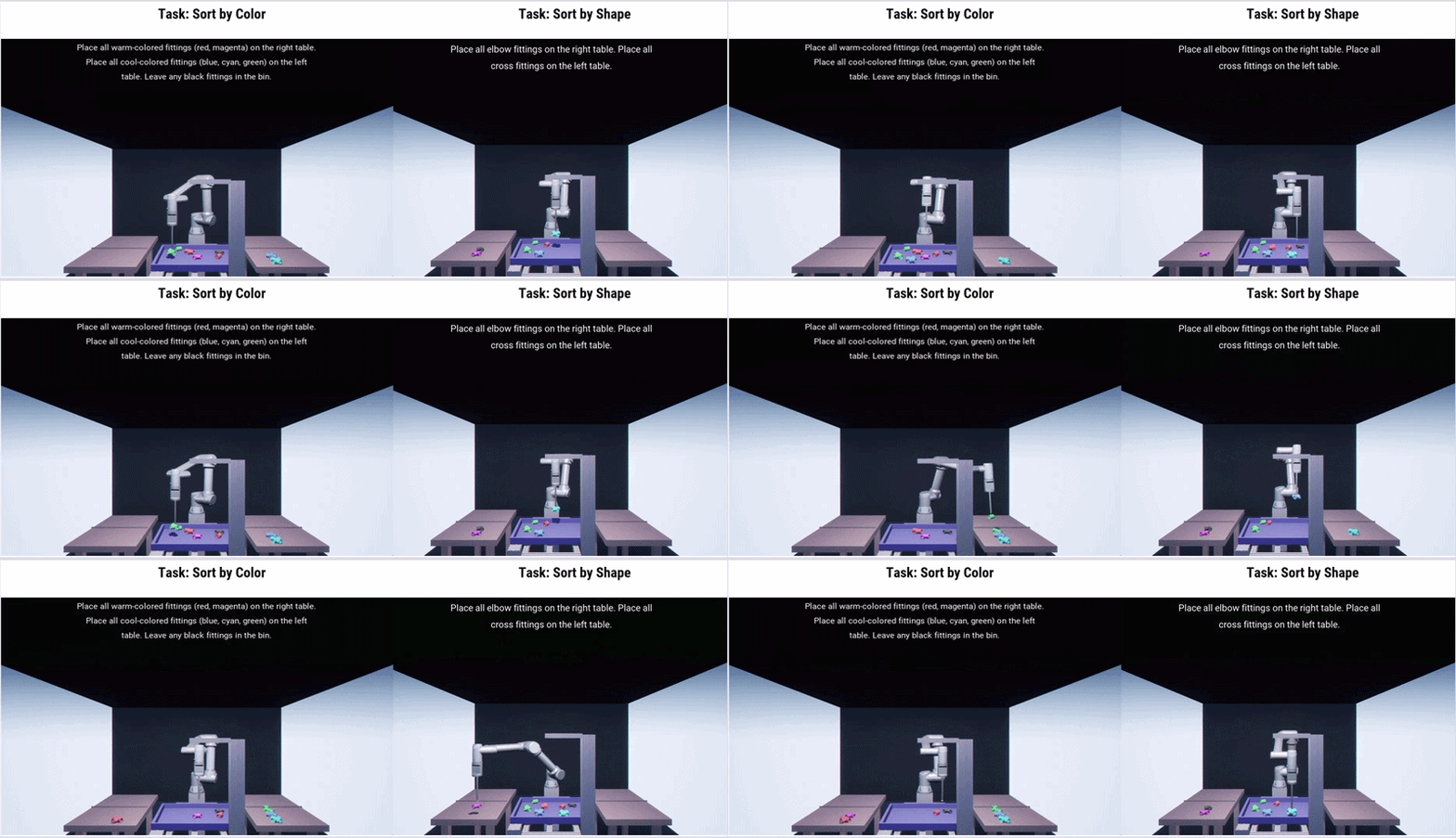
By separating reasoning from execution, the external model can change while the engineering workflow remains largely intact.
The same MATLAB and Simulink components can continue to provide: Robot models, Coordinate systems, Collision environments, Motion planners, Controllers, Simulation scenarios, Test cases for safety, Hardware interfaces, and Deployment workflows
This allows engineers to compare external reasoning models using a consistent robotics environment rather than rebuilding the complete system for every model.
It also makes it possible to test the two layers independently. The reasoning model can be evaluated on object selection, task decomposition, spatial understanding, and completion detection. The execution layer can be evaluated on reachability, planning success, collision avoidance, trajectory quality, and controller performance.
7 How This Differs from the VLA Approach
The VLA approach described in the first article combines perception, planning, and robot action within a learned model.
The embodied reasoning architecture separates high-level intelligence from robot execution. In this architecture, the VLM-based model interprets the scene and task, while the robotics engineering tools generate and execute feasible robot motion.
| End-to-end VLA | VLM plus Engineering Tools |
| . Model generates robot actions | . Model generates task goals and decisions |
| . Perception and action are learned together | . Reasoning and execution are separated |
| . Well suited for learned, adaptive behavior | . Well suited for constraint-aware workflows |
| . Behavior depends heavily on training | . Execution uses explicit models and algorithms |
| . Full policy is evaluated as one system | . Reasoning and execution can be tested separately |
The two approaches can also be combined. An embodied reasoning model could select a task and determine the task sequence. A VLA policy could execute a dexterous subtask such as grasping a deformable object. A conventional planner could handle free-space robot motion. A feedback controller could execute the final trajectory.
The right architecture does not have to be entirely learned or entirely model-based.
8 The Role of MATLAB and Simulink
The value of MATLAB and Simulink in this workflow is not to compete with large external foundation models.
Their role is to connect those models with the engineering processes required to build working robotic systems.
That includes: Converting semantic task outputs into robot goals, Evaluating feasibility using robot models, Planning and controlling robot motion, Simulating the complete closed-loop workflow, Testing normal and failure scenarios, Comparing learned and algorithmic approaches, Integrating sensors, algorithms, and hardware, and Moving from desktop prototypes to deployment targets.
Embodied reasoning provides adaptability at the task level. MATLAB and Simulink provide structure, analysis, and repeatability at the execution level.
9 From Generative AI to Physical AI
The first wave of generative AI for robotics demonstrated the potential of end-to-end models that connect language, vision, and action.
The next step is integrating these capabilities into complete engineering systems.
External embodied reasoning models can provide adaptability, semantic understanding, and task verification. MATLAB and Simulink can provide the algorithms and engineering workflows required to convert those decisions into feasible, testable, and deployable robot actions.
The story is therefore not foundation models versus classical robotics.
It is a complementary architecture:
- Embodied reasoning for understanding the scene and task
- Task verification for monitoring progress
- Robotics algorithms for planning and control
- Simulation for integrated system evaluation
- Model-Based Design for testing and deployment
Embodied reasoning helps a robot understand what should happen next.
MATLAB and Simulink can help turn that understanding into robot actions that are feasible, testable, repeatable, and deployable.
That complementary architecture provides a practical path from generative AI reasoning to reliable action in the physical world. If you are interested in exploring this workflow or applying it to your robotics application, please reach out to us.
- カテゴリ:
- AI in Robotics






コメント
コメントを残すには、ここ をクリックして MathWorks アカウントにサインインするか新しい MathWorks アカウントを作成します。