
Beyond Links: Which Kind of Digital Thread Are You Actually Building?
Why simulation-driven digital threads are the difference between connected data and digital engineering
The Problem Is Not the Lack of a Digital Thread, It Is the Type
Over the last decade, the term digital thread has become nearly universal in engineering organizations. Many teams can point to connected requirements, descriptive system models, design models, CAD models, analysis artifacts, and reports, and confidently say they have a digital thread.
But here’s an example of the type of question that matters when reality hits:
When a requirement changes late in development, what happens next?
Do teams quickly understand the behavioral impact and regenerate evidence with confidence? Or do they simply get a longer list of artifacts to chase down, review, and interpret? The harder and more important question isn’t whether you have a digital thread. It’s what your digital thread actually enables when change happens.
Does it simply help teams locate impacted artifacts? Does it help govern and control them? Or does it help predict how the system will behave as conditions, requirements, or designs change?
Not all digital threads are created equal, and the differences matter.
Three Digital Threads That Often Get Confused
Many organizations use the same language to describe very different capabilities. Clarifying these distinctions helps teams understand where they truly are and what it would take to move forward.
1. Descriptive and Link Enabled Digital Threads
Descriptive digital threads focus on connecting artifacts. Requirements link to documents or system models, CAD links to analysis results, and models reference one another across tools. This approach improves visibility and navigation. Teams can trace relationships and identify which artifacts might be impacted by a change.
However, the system itself is never executed as a whole. Behavior is described, sometimes stepped through, but not dynamically evaluated over time and across domains. When change occurs, impact analysis is largely manual and dependent on expert interpretation.
This is the digital equivalent of a static map. It is useful for orientation, but blind to timing, conditions, and dynamic behavior.
2. Product Lifecycle Management (PLM) Enabled Digital Threads
PLM enabled digital threads build on descriptive threads by adding lifecycle governance. Versioning, baselines, configuration control, and approvals improve trust and repeatability. This creates a strong foundation for collaboration across large programs. Artifacts are controlled, traceable, and auditable across the lifecycle.
But in many cases, system behavior is still inferred rather than computed. Models and analyses remain siloed, and validation often occurs late.
A helpful way to think about it:
PLM can make your “map” more trustworthy. Accurate roads, clear version history, reliable signposts, but it still doesn’t tell you traffic, weather, or ETA.
In other words: PLM makes the digital thread trustworthy, but not predictive.
One common gap: PLM-enabled threads often govern hardware artifacts well but underspecify the software lifecycle where requirement changes, defects, change requests, builds, and test evidence move quickly. In practice, teams need a thread that includes not only product definition, but the “software delivery reality”: requirements workflows, change/defect tracking, test management, and release records. That’s why bidirectional traceability between model elements, requirements, tests, and lifecycle work items becomes essential and why many teams rely on integrations and partners to connect these systems.
3. Simulation Driven Digital Threads
Simulation driven digital threads fundamentally change what the thread can do. Architecture, behavior, physics, control, software, and test models are composed and executed together. Time becomes a first-class concept. System behavior emerges from interactions across domains, managed by a simulation engine rather than manual orchestration.
Executable does not mean “more analysis.” It means the thread can run the system behavior and verification activities end-to-end.
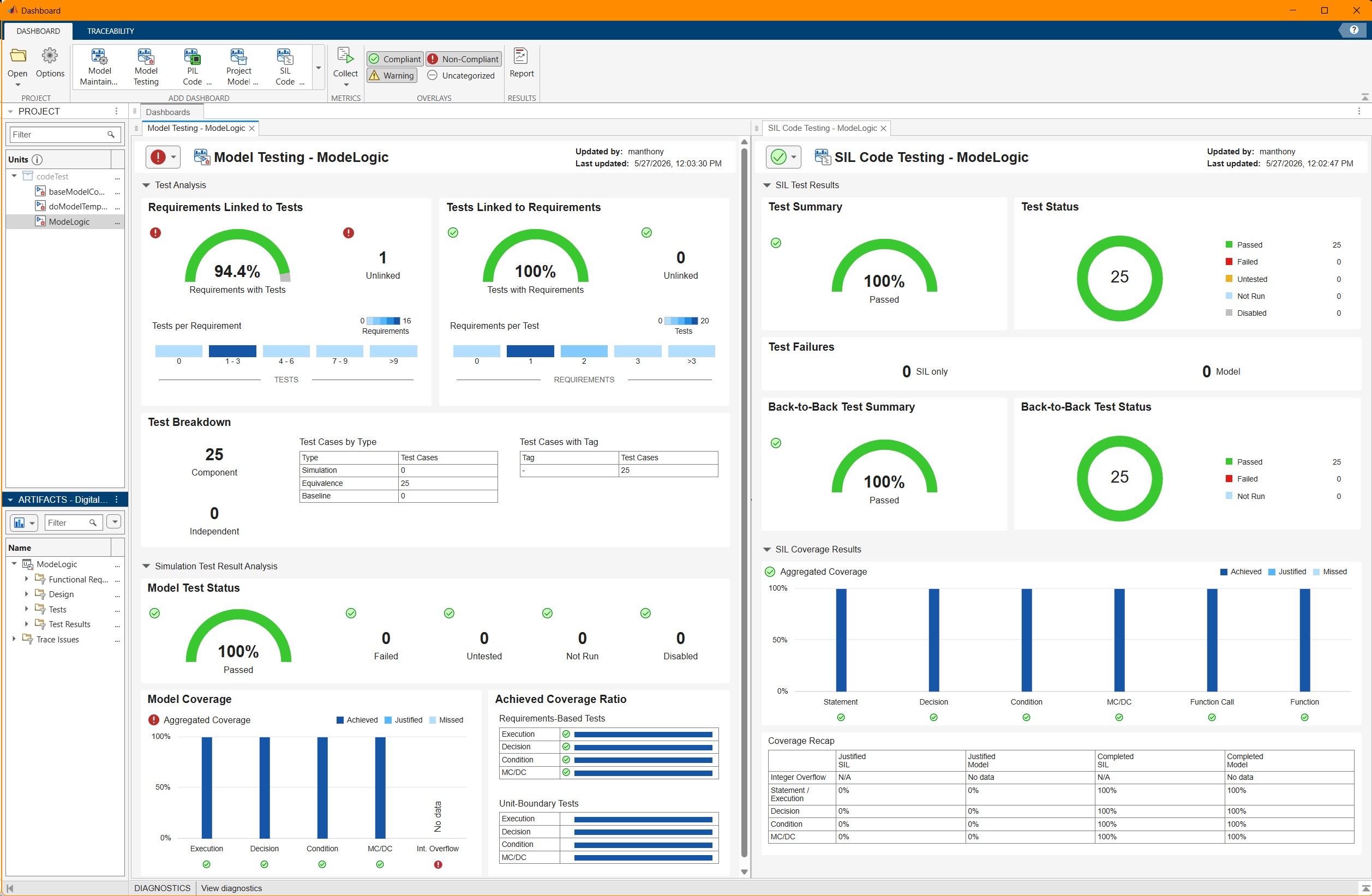
That’s the turning point: the thread becomes predictive when it can recompute behavior and continuously refresh verification status as the product evolves. When change occurs, teams can re-simulate the system and immediately understand behavioral impact, performance tradeoffs, and risk.
This represents the Google Maps moment for digital engineering. The digital thread does not just connect artifacts. It continuously predicts outcomes and informs decisions.

Using the Five Quick Tests as a Diagnostic
In the previous post, we introduced five quick tests to assess whether an organization is truly practicing digital engineering. Viewed through the lens of digital threads, these tests become diagnostics of capability rather than tooling maturity.
Five Quick Tests: Is Your Digital Thread Simulation Driven or Just Linked?
1) Trace: Can you navigate requirements ↔ architecture ↔ design ↔ tests/results in both directions?
2) Detect staleness: When something changes, does the system automatically flag what evidence is now outdated?
3) Simulate: Can you run system behavior through time (not just step through) to predict system behavior?
4) Automate selectively: Can CI/CD rerun only impacted tasks/results, not everything?
5) Scale: Does this work across variants/fidelity levels and across teams/tools without constant manual glue?
How to interpret this: Descriptive threads often pass #1 only; PLM-enabled threads usually add governance and may partially address #2; simulation-driven threads are the only ones that reliably pass #2–#5.
Using models as the source of truth separates basic, descriptive digital threads from model‑first approaches. But if reviews still revolve around documents, the workflow remains document‑centric. Continuous verification and rapid change impact analysis are only achievable with simulation driven digital threads.
Here’s a simple additional test:
If your digital thread cannot execute system behavior over time and across domains, it will never be predictive, regardless of how well artifacts are linked or governed.
Why This Distinction Matters
Connected data alone does not accelerate decisions. Governed data alone does not reduce risk. Digital engineering delivers value when teams can predict system behavior early and continuously.
No single vendor covers the entire enterprise thread end-to-end (mechanical/CAD, EDA, manufacturing, software, test), which is why integration and partner ecosystems matter as much as any single toolchain.
Simulation driven digital threads enable that shift by turning models into decision making assets rather than documentation artifacts.
Organizations do not need to abandon existing investments to move forward. The opportunity is to evolve the digital thread from descriptive, to governed, to predictive.
Reaching the Google Maps Moment
Paper maps helped. Early digital maps helped more. The breakthrough came when navigation systems began predicting conditions and adapting in real time.
Simulation-driven digital threads provide the same leap for digital engineering. Teams move from documenting intent to continuously informing decisions, faster and with higher confidence.
A quick note on terminology: People also ask how “digital thread” relates to “digital twin.” They’re often used together, but they are not the same thing. Confusing them leads to mismatched expectations. We’ll tackle that distinction (and why it matters) in a follow-up post.
So, ask yourself, when something changes tomorrow, does your digital thread simply tell you what was impacted, or does it tell you what will happen?




评论
要发表评论,请点击 此处 登录到您的 MathWorks 帐户或创建一个新帐户。