
Startup Spotlight: Turning Software Defined Sensing into Real-Time Intelligence
Modern devices are extraordinarily capable. Yet most still perceive the world the same way a human eye does, seeing color and shape but missing the deeper information the light spectrum contains. Far more exists in that spectrum than conventional sensors can capture, and for decades, it has remained out of reach.
Agate Sensors is changing that with the world’s first fully software-defined hyperspectral chip that brings lab-grade spectral intelligence to an ultra-compact, mass-manufacturable form factor. By shifting intelligence from rigid, costly hardware to software, the team is making what was once inaccessible far more accessible.
“By bringing lab-grade hyperspectral capabilities to an ultra-compact, fully software-controlled chip, we are redefining spectral measurement and defining a new category of capabilities that simply did not exist before,” says Mikael Westerlund, Chief Business Officer and Co‑founder of Agate Sensors.
Breaking the limits of conventional sensors
Most sensors used in consumer and industrial devices today are built around fixed optical architectures that rely on filters or specialized optics to separate incoming signals before detection. While effective for traditional imaging, they impose hard trade-offs in terms of size, cost, and flexibility.
Agate Sensors takes a fundamentally different approach. “We are not using any filters or diffractive elements to separate wavelengths before detection,” explains Westerlund. “Because we use all available signal energy, the signal-to-noise ratio at the detector level is dramatically better. And without filters, the platform becomes inherently smaller, cheaper to manufacture, and scalable in ways conventional architectures cannot match.”
By eliminating the need for specialized optics, Agate Sensors enables a solid‑state sensing platform that is compact, robust, and highly programmable. Instead of designing a new sensor for every application, device manufacturers can adapt the same platform through software, shifting sensing behavior as requirements change.
This shift is especially important because innovation in conventional sensing has largely plateaued. As Westerlund notes, traditional imaging systems have focused on incremental improvements, such as higher pixel counts, rather than fundamentally new capabilities. “That development has stagnated totally,” he says. “It’s been years since we’ve seen something really new on these devices.”
By moving innovation into software, teams can explore new applications without re‑engineering hardware, reducing development time and lowering the barrier to experimentation.
As a result, a single sensing platform can support a wide range of use cases, from health monitoring and material identification to machine vision and environmental sensing.
From raw data to real‑time intelligence
At the heart of Agate Sensors’ platform is the ability to extract meaningful insight from rich spectral data. “Spectral data is an underutilized natural resource today because current technology is big, bulky, expensive, and impossible to miniaturize,” says Westerlund. “By miniaturizing this technology and making it affordable, it can be integrated into devices like mobile phones, wearables, cars, drones, and even satellites.”
This is exactly what Agate Sensors has achieved by enabling spectral data to be captured and interpreted in real time across many domains.
In wearables, for example, hyperspectral sensing could analyze biochemical signals without needles or test strips. In other applications, devices could identify materials or detect hazards in the field.
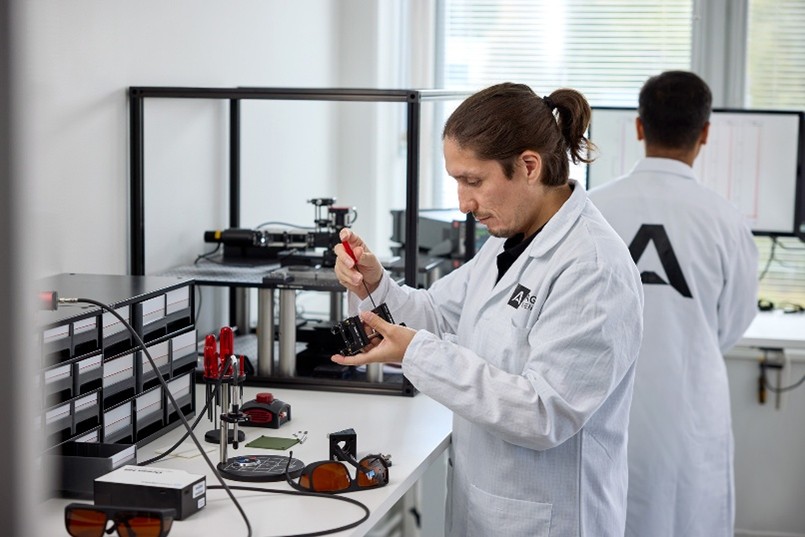
Agate Sensors develops technology to bring lab-grade hyperspectral capabilities to ultra-compact, fully software-controlled chips. (Image courtesy of Agate Sensors)
This approach also aligns naturally with artificial intelligence. “Current sensors are built to replicate how humans see the world,” Westerlund explains. “What we provide is much richer data that AI can use far more efficiently than humans ever could.”
Rather than producing images meant for people to look at, Agate Sensors’ platform generates measurement data designed for machines to analyze. Instead of being limited to red, green, and blue channels, devices gain access to deeper information that AI models can use to identify materials, detect signals, and make real-time decisions.
“This technology is really a match made in heaven between machine vision and AI‑driven applications,” Westerlund says. Turning this kind of data into reliable, real‑time intelligence depends not just on sensing, but on the algorithms that interpret it.
Using MATLAB to accelerate algorithm development
MATLAB plays a central role in Agate Sensors’ workflow, particularly during the algorithm development and validation phases, providing the accuracy and analytical depth needed to work with large, complex datasets.
As prototypes generate large volumes of complex data, MATLAB enables the team to explore, analyze, and iterate quickly. Agate Sensors relies on toolboxes such as Signal Processing, Image Processing, and Computer Vision to support these workflows. “MathWorks is a central tool for our algorithm development,” explains Tommi Leino, CEO and Co-founder of Agate Sensors. “We use MATLAB for spectral reconstruction, signal processing, and analyzing measurement data during development”.
MATLAB also helps bridge the gap between research and deployment. Once the algorithms are developed, the team uses MATLAB Coder to generate C code that runs on the CPU in their chip.
For a startup building custom chips, that continuity matters. “It definitely speeds up algorithm development because you have ready‑made toolsets and functions instead of coding everything from scratch,” Leino adds.
Moving fast from research to silicon
The core innovation behind Agate Sensors originated in academic research but turning that breakthrough into a scalable product requires both speed and technical rigor.
Like many deep‑tech startups, Agate Sensors operates under intense time pressure. Hardware development demands significant upfront investment, while customers expect rapid progress toward real‑time deployment. “Time is essential in the startup world,” says Leino. “We need to execute fast and still deliver high‑quality output for customers.”
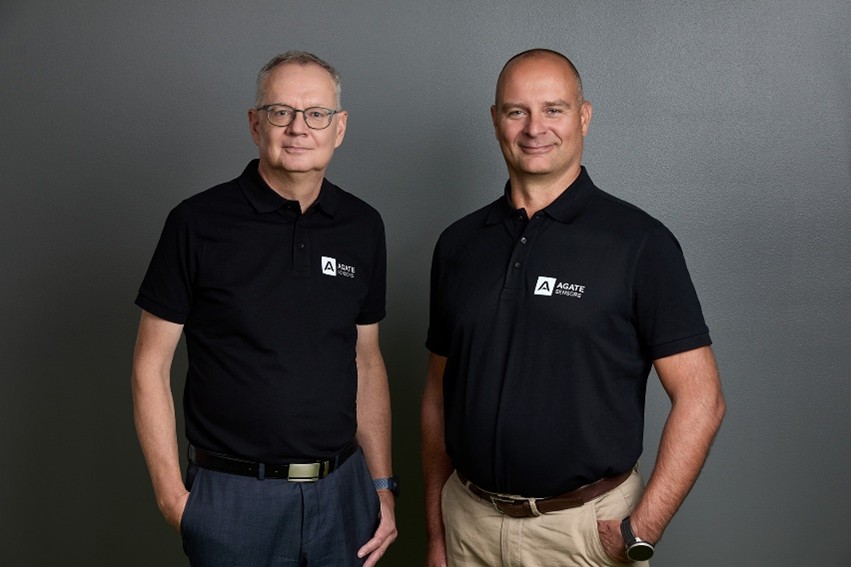
Tommi Leino, CEO and Mikael Westerlund, CBO of Agate Sensors. (Image courtesy of Agate Sensors)
That urgency has shaped how the team approaches development. By focusing on software-defined sensing and a streamlined path from algorithms to silicon, Agate Sensors moves from research concepts to deployable hardware without sacrificing accuracy or flexibility.
Looking ahead
Agate Sensors is approaching a major milestone: receiving its first silicon back from the foundry. From there, the focus shifts to validation, customer proofs of concept, and preparing for mass production.
The longer‑term vision is clear. By embedding software-defined sensing into everyday devices, Agate Sensors aims to enable a new generation of intelligent systems that can perceive, classify, and understand the physical world in ways previously impossible.
For researchers and engineers considering a similar leap from academia to industry, the team’s advice reflects their own journey. “Close your eyes and jump,” concludes Westerlund. “You’ll never know if you don’t do it.”
Sometimes, the biggest breakthroughs come not from adding more hardware, but from rethinking where intelligence belongs.
- カテゴリ:
- Startup Spotlights




コメント
コメントを残すには、ここ をクリックして MathWorks アカウントにサインインするか新しい MathWorks アカウントを作成します。