
Are You Focusing on the Wrong Parts of Digital Transformation?
Surprising Insights from Aerospace & Defense Engineers
If you are leading digital transformation in engineering, it is easy to assume the next step is more tools, more infrastructure, and more modernization. In many cases, that is part of the answer. But our recent survey of aerospace and defense engineers suggests it is not the whole answer. The bigger issues may be less about getting new tools into the organization and more about making engineering work actually connect across teams, artifacts, and decisions.
That is what stood out to us in the survey results. Yes, respondents pointed to investment in new tools and environments as a top request to leadership. But they also pointed, very clearly, to interoperability, traceability, steep learning curves, and the challenge of moving away from legacy artifacts and processes. And one result stood out even more: strong interest in using system-level architecture models for simulation, tradeoff analysis, and validation.
That last point is worth sitting with for a minute. It suggests that many teams are not just looking for more models or more digital artifacts. They are looking for models they can actually use. Models that help them explore alternatives, make decisions earlier, and validate system behavior with more confidence. That feels like a much more revealing signal than a generic statement about digital transformation.
What the survey is really saying
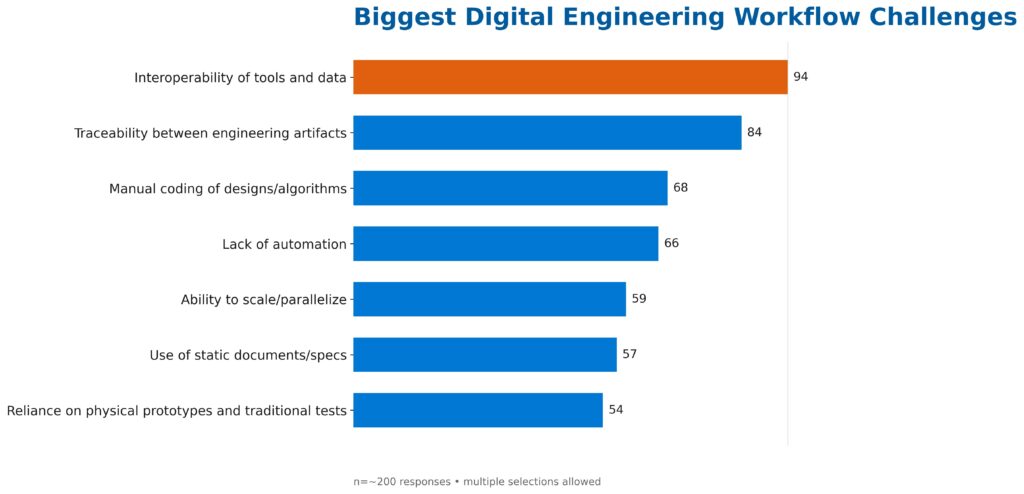
Respondents could select more than one response, so percentages do not sum to 100%.
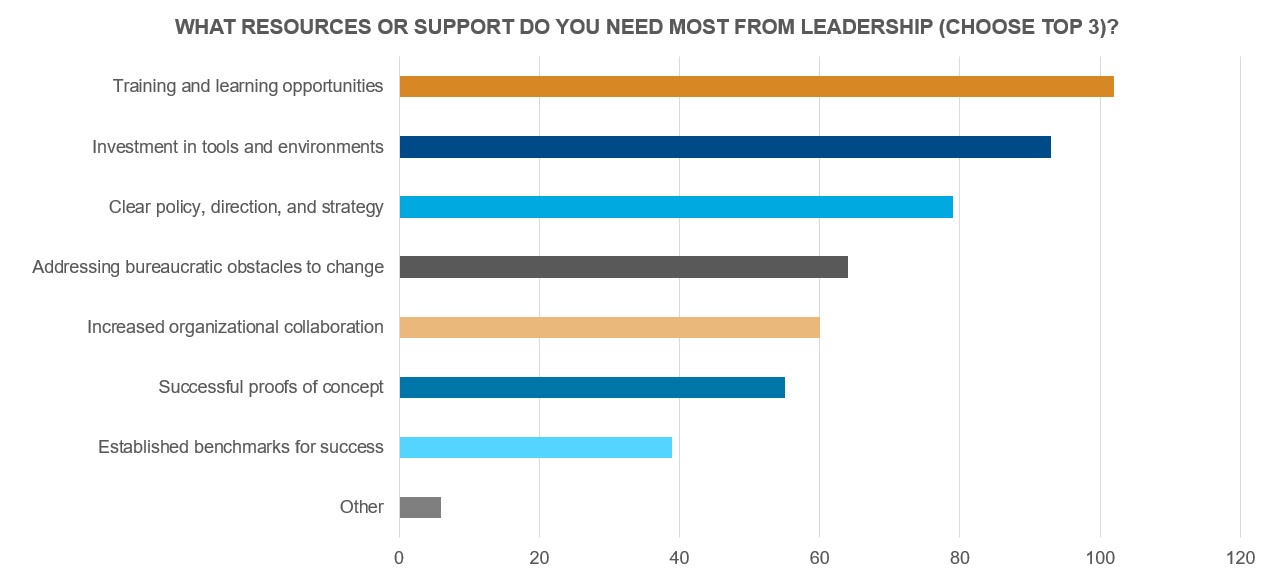
Tools are only part of the story. A few survey results tell the story pretty quickly. More than half of respondents, 56%, said investment in new tools and environments is a top request to leadership. At the same time, the top digital transformation initiatives underway were digital twin at 55% and digital thread at 53%. Those are big, strategic efforts. No surprise there.
The biggest gaps are still foundational. But here is the tension. The biggest pain points were not a lack of named initiatives. They were tool and data interoperability at 56% and traceability between engineering artifacts at 50%. In other words, many organizations are aiming for digital twin and digital thread while still struggling with the basics that make those efforts useful in practice. If tools do not connect and artifacts do not trace cleanly, the bigger vision starts to wobble pretty quickly.
Engineers want models they can actually use. Then there is the result we found especially interesting: 60% of respondents said they want to learn more about using system-level architecture models for simulation, tradeoff analysis, and validation. To us, that says something important. It says that for many engineers, the next step is not just having architecture models, it is making those models executable enough to support real engineering work.
That is a meaningful distinction. A model that documents architecture is useful. A model that helps you analyze tradeoffs, validate behavior, and inform decisions is much more powerful. If a lot of engineers are asking for that capability, it suggests many transformation efforts still have a gap between creating digital artifacts and getting real engineering value from them.
The people side may be the hardest part. The people side of the story is just as clear. Eighty percent of respondents cited a significant learning curve as a major hurdle to adopting new processes and technologies. Seventy-nine percent pointed to the challenge of transitioning from legacy artifacts and processes. That should be a reminder that digital transformation is not just a tooling problem. It is also a workflow and adoption problem. If the new way of working is too hard to adopt, teams will keep falling back to the old one.
And all of this is happening under time pressure. Nearly all respondents, excluding those who answered “unsure,” said they need to achieve a digital transformation goal within the next 18 months. So there is urgency, but the survey suggests that moving faster is not the same as moving effectively. If the foundation is weak, speed just exposes the cracks sooner.
Why this matters
Digital transformation only matters if engineering work improves. One thing we have talked about before is that digital transformation is a broad term, while digital engineering is much more specific. Digital transformation can mean many things across an organization. Digital engineering is about how engineering work actually gets done: how teams design, connect, verify, maintain, and improve complex systems over time. That distinction matters here. These survey results are interesting precisely because they point to the practical frictions inside engineering work, not just the broad ambition around transformation.
If that is true, then the takeaways are fairly straightforward.
Interoperability matters because disconnected tools and data make it hard to create usable workflows across disciplines. Traceability matters because teams need to understand how a change in one place affects the rest of the system, without resorting to manual detective work. System-level models matter most when they can support simulation, tradeoff analysis, and validation, not just documentation. And skills matter because even the best workflow will stall if teams cannot realistically adopt it.
The real goal is better connected engineering work. Taken together, the survey points to a simple but important idea: digital transformation in engineering is not just about modernizing the toolset. It is about making engineering work more connected, more analyzable, and more practical to execute.
A few questions worth asking
If you are leading digital transformation in engineering, this survey raises a few useful questions.
- Is your transformation plan mostly a tooling plan, or does it also address interoperability, traceability, and adoption?
- Can your teams connect requirements, models, code, test results, and decisions without a lot of manual effort in between? That is the kind of gap the survey’s interoperability and traceability results seem to be pointing to.
- Are your system-level models informative documents, or are they useful assets for simulation, tradeoff analysis, and validation? The strong interest in that topic suggests many teams see it as the next meaningful step.
- And are you expecting people to transform with the tools, or are you giving them a realistic path to adopt new workflows without getting buried by the learning curve and legacy transition?
Closing thought
If there is one message we would take from the survey, it is this: organizations may be investing in the visible parts of digital transformation while underestimating the harder, more foundational work underneath. Tools matter. But connected workflows, traceability, model usability, and the ability of teams to adopt new ways of working matter just as much, and maybe more. If those pieces are weak, the transformation effort will feel bigger than it is. If they are strong, the rest starts to become much more achievable.





コメント
コメントを残すには、ここ をクリックして MathWorks アカウントにサインインするか新しい MathWorks アカウントを作成します。