
Startup Spotlight: Quix Eliminates Data Friction to Advance Engineering Workflows
When engineers can’t access or trust their data, innovation stalls. Teams struggle with fragmented data and manual workflows that slow automated testing and data-driven development. Quix, a startup company, is on a mission to centralize engineering data, empowering engineers to harness advanced analytics without the heavy lift of complex IT projects.
The Problem: Data Silos Hold Engineers Back
Engineering organizations generate tons of data, but much of it is scattered across laptops, servers, test rigs, and disconnected tools. Mike Rosam, CEO of Quix, explains, “That really prevents engineers from using more modern analytical techniques like data science, machine learning, and AI at scale.” The result is an undesirable, slower time to market, lower product quality, and missed opportunities for automation.
Organizations trying to overcome this have a few decisions. They can build a custom in-house system, which can be expensive and complex to maintain, hire consultants for a digital transformation, again costly, or buy an enterprise platform, requiring customization and long deployment timelines. “Every R&D organization in the world has its unique processes,” Rosam notes. “It’s really hard to buy a standardized product that you can just purchase like a CRM for marketing data.”
The Solution: Quix – A Platform Built for Engineers
Quix flips the script with a developer platform designed for engineers. “We’re a Python-native development environment, so engineers can build their own workflows in languages they already use,” Rosam describes. “There’s no DevOps. Engineers write Python scripts, deploy them, and they’re up and running.”
The platform handles two major jobs:
- Data Ingestion: Quix makes it easy to build data pipelines from test rigs, labs, and simulation tools, normalizing and enriching data for analytics. Engineers customize connectors using AI‑assisted code generation, then route data into a centralized warehouse. Metadata from configuration systems is automatically merged, allowing downstream tools to consume analytics-ready datasets. Mechanical and test engineers can set up pipelines themselves without IT tickets or delays.
- Analysis and Automation: Once data is centralized, engineers can pull it into the tool they prefer. From MATLAB and Simulink to Jupyter Notebooks or custom tooling, the open structure enables hybrid toolchains rather than locking teams into one environment. A powerful use case is to automate event-driven analysis, triggering simulations, validation routines, or model-based workflows as soon as new test data arrives. Rosam explains, “We’re really trying to automate all of those steps in the engineering workflow and let engineers build their own workflows.”
“A big differentiator for Quix is it’s very open,” Rosam notes. “We can get data from any R&D tool, any physical system, into a consolidated cloud and let engineers pull the data into any tool.”
Seamless Integration with MATLAB and Simulink
Quix’s platform is deeply integrated with MATLAB and Simulink. “We use MathWorks tools every day to help our customers solve problems,” Rosam says. “The integrations we’ve built make it easy for engineers to acquire data from simulations and serve models in the cloud.” Engineers can use a Simulink block to stream data from Simulink models directly into Quix Cloud. They can run MATLAB and Simulink models inside Quix against live or historical data streams. Or parameterize models dynamically for real-time digital twin applications.
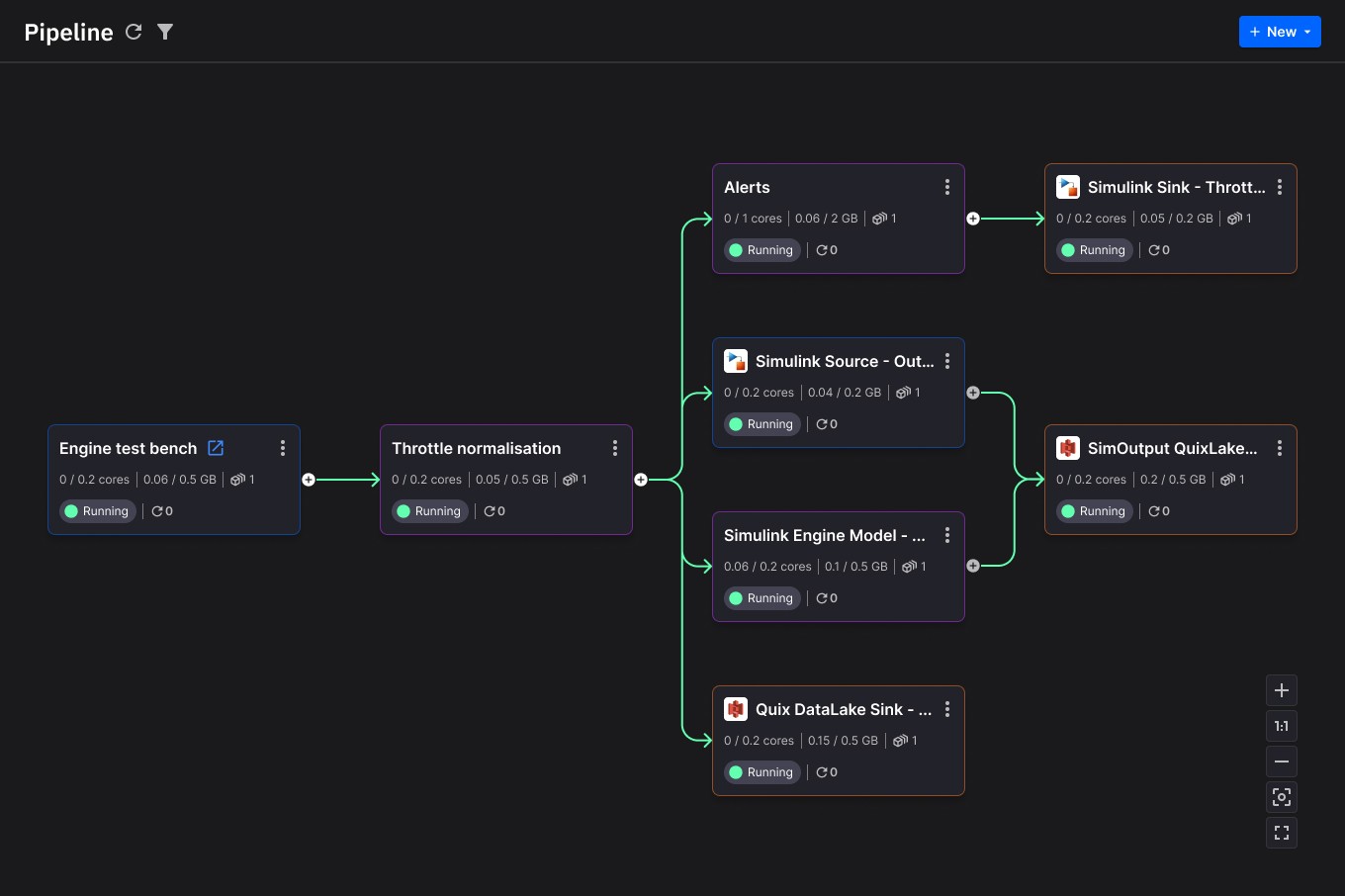
The Quix.IO platform seamlessly integrates data into Simulink. (Image courtesy of Quix)
Quix’s approach is already penetrating industries from motorsport to manufacturing. For example, a Formula One team uses the platform to run digital twin models in real time as the car is driving. When the car changes the front wing angle, engineers update the parameter, and the digital model running in Quix adjusts instantly. This keeps the virtual system aligned with reality, which is critical for verification and validation.
“We work in a very practical way,” Rosam emphasizes. “We identify a key bottleneck in the R&D process and fix that quickly, sometimes within a month or two. This isn’t a years-long, million-euro digital transformation. It’s pragmatic, high-impact problem-solving.” This model has helped customers accelerate simulation workflows, improve validation cycles, and close data loops between physical and digital environments.
Partnering with MathWorks Startup Program
For Quix, MathWorks Startup Program has been a foundational partner. The startup joined the program early to obtain access to MATLAB to help a customer. This quickly grew into a much more collaborative partnership. “Startups are cash-constrained, so the Startup Suites is a no-brainer,” Rosam shares. “But the support has been unrivalled. MathWorks went the extra mile, from account support, engineering support, even marketing support. We haven’t seen this level of support from other tech vendors.”
For a lean startup managing product development, customer success, and operations, this support saves both time and capital.
What’s Next for Quix
Quix is growing rapidly. They are looking forward to opening new offices in Prague and London. The team is hiring, launching new initiatives, and looking ahead to future funding rounds. Their mission remains the same, to remove data friction so engineers can focus on engineering. Rosam concludes, “When a customer says, ‘You changed the way we work,’ that’s the reward. We want to deliver that every day.”
Learn more about Quix: https://quix.io/
Learn more about MathWorks Startup Program: https://www.mathworks.com/products/startups.html




댓글
댓글을 남기려면 링크 를 클릭하여 MathWorks 계정에 로그인하거나 계정을 새로 만드십시오.