
Mission Engineering for Complex Aerospace Systems: Five Patterns Shaping Modern Programs
Today’s guest writer is Satish Thokala, Industry Marketing, Aerospace and Defense at MathWorks.
The Challenge: Complexity Is Outpacing Traditional Methods
In Aerospace and Defense, mission complexity is growing faster than the ability to manage trade‑offs effectively. UAV operations are evolving from single-vehicle missions to multi-asset, coordinated systems operating in dynamic environments, while satellite architectures are shifting towards large constellations that require true system-of-systems thinking. At the same time, program timelines are shrinking, even as expectations for performance, resilience, and interoperability continue to rise.
The fundamental question facing engineering teams is no longer “Can we build it?” It is increasingly becoming, “Can we make the right decisions early enough?”
This is where Mission Engineering plays a critical role. It helps teams connect requirements, architecture, analysis, and verification to enable better decisions earlier in the lifecycle.
Mission Engineering: Enabling Better Decisions, Earlier
Mission Engineering focuses on evaluating systems in the context of real mission outcomes, rather than isolated component performance. By leveraging Model‑Based and digital engineering approaches, teams can:
→ Explore design alternatives quickly
→ Analyze trade‑offs before costly decisions are locked in
→ Validate concepts earlier using executable models
→ Reduce rework caused by late discovery of requirements or integration issues
As Aerospace systems grow more complex, engineering teams are rethinking how they design, analyze, and validate missions. Traditional component-level approaches are often insufficient for understanding system behavior, trade-offs, and risk at the mission level, especially early in the lifecycle.
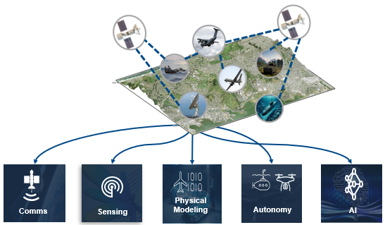
Modern aerospace missions are no longer defined by individual platforms, they are defined by how systems interact across communications, sensing, modeling, autonomy, and AI to achieve mission‑level outcomes.
Across aerospace programs, a common set of patterns is emerging in how teams approach mission‑level modeling and decision‑making. The following themes reflect those patterns and highlight where mission engineering is having the greatest impact.
1. Fidelity Needs to Be Intentional
Not every decision requires high‑fidelity models. In fact, insisting on maximum fidelity at every stage can slow progress.
An effective mission engineering approach applies fidelity intentionally:
• Use lower‑fidelity models for early exploration and rapid trade studies
• Increase fidelity as design decisions narrow and risk areas become clearer
• Define clear success criteria to understand when “good enough” is sufficient
This approach enables teams to move faster while still making informed decisions.
2. Digital Continuity Is Critical
Disconnected tools and handoffs remain a major cause of delays and rework in aerospace programs.
A strong Mission Engineering approach is built on digital continuity, connecting:
• Requirements
• System architecture
• Analysis and simulation
• Verification and validation
When these elements are digitally linked, teams can assess the impact of changes instantly, maintain traceability, and keep stakeholders aligned throughout the lifecycle.
3. Satellite Constellations Are Communication‑Driven
For satellite constellations, mission success is no longer defined by the performance of a single spacecraft.
The focus shifts to:
• Coverage and revisit rates
• Network resilience
• End‑to‑end communication performance
• Behavior under constraints such as link failures or congestion
Mission-level modeling allows teams to evaluate constellation behavior holistically, ensuring that system-level objectives are met, even under non-ideal conditions.
4. UAV Missions Demand Interoperability
Modern UAV missions involve multiple platforms, ground systems, and stakeholders. As a result, interoperability becomes a core design consideration.
This requires:
• Alignment between mission requirements and system architecture
• Shared models that span disciplines and organizations
• Verification strategies that reflect operational realities, not just nominal cases
Mission Engineering helps ensure that all elements of a UAV ecosystem work together as intended.
5. Resilience Matters More Than Nominal Performance
Optimizing solely for ideal conditions is no longer sufficient for complex aerospace missions.
Teams need to evaluate system behavior under disruption, including:
• Degraded communications
• Asset loss or failures
• Environmental uncertainty
• Adversarial or contested scenarios
Mission‑level analysis helps uncover vulnerabilities early and guides more resilient system designs.
Looking Ahead
For aerospace startups and innovators, Mission Engineering is quickly becoming a competitive advantage. By focusing on early insight, intentional fidelity, and connected digital workflows, teams can reduce risk, accelerate development, and deliver systems that perform not only on paper but in real missions.
As mission complexity continues to increase, the ability to decide early, model wisely, and design for resilience will define the next generation of aerospace innovation.
Innovating Mission Engineering for Tomorrow Webinar Recordings
If you want to explore these ideas in more depth, recordings from the Innovating Mission Engineering for Tomorrow series are available here:
- Engineering UAV Missions: Digital Tools for Complex Scenarios
- Mission Engineering for Satellite Constellations
Each session includes practical examples, workflows, and demonstrations using MATLAB® and Simulink®, showing how digital tools can support mission‑level decision‑making from concept through validation.




댓글
댓글을 남기려면 링크 를 클릭하여 MathWorks 계정에 로그인하거나 계정을 새로 만드십시오.