
From Engineer to Founder: Building Bay Area Sonic Solutions
Most engineering teams know how to build a prototype. Not every team feels confident explaining exactly what that prototype is doing, especially early in development. Measurement can lag behind innovation, not because it is unimportant, but because it is complex, time‑consuming, and easy to postpone until the stakes are higher.
Leela Pawashe has spent her career working in that gap. Across academia, startups, and large medical device companies, she has focused on measuring complex physical systems and helping teams understand what their data actually means.
Today, through her startup Bay Area Sonic Solutions, she is bringing that experience to early-stage teams, starting with ultrasonic devices, but grounded in principles that apply far beyond a single technology.
A Broader View of Ultrasound
When Pawashe talks about ultrasound, she is not just talking about the imaging system you might see in a doctor’s office. She is referring to a broad and rapidly evolving technology landscape spanning medical imaging, therapeutic ultrasound, and industrial inspection.
Ultrasound is sound at a frequency humans cannot hear, typically above 20 kilohertz. That range supports applications such as breaking up calcified lesions in blood vessels or enabling new approaches to neuromodulation and drug delivery. Despite the diversity of use cases, many of these technologies share common measurement challenges.
“One of the things I love about measurements is that no matter what type of device you are developing, there are similar principles you can apply,” Pawashe explains. “It’s about understanding what parameters actually matter for your application.”
From Standards Committees to Startup Founder
Before starting her company, Pawashe built a career at the intersection of ultrasound physics, measurement, and standards development. Her work spans ultrasound imaging, elastography, and cavitation physics, as well as the head of acoustics at a pioneering intravascular lithotripsy company that later grew rapidly and was acquired.
Alongside her industry work, she serves on the IEC TC 87 Ultrasonics Committee, which develops international ultrasonic measurement standards, and she is the international project leader for the IEC 63612 standard focused on characterizing ultrasonic short-pressure pulse therapy. “That combination of industry experience and standards work really shaped how I think about measurements,” Pawashe says. “You want measurements that are rooted in standards, but you also need flexibility, especially when you are working on something new.”

Leela Pawashe sets up her testing rig for ultrasound measurement. (Image courtesy of Bay Area Sonic Solutions)
Why Early Measurement Matters
Across her work with startups and multinational companies, Pawashe has seen a consistent pattern. Teams often delay ultrasound testing until late in development, either because early testing feels premature or because validated studies are expensive and slow. “What I kept seeing was that there are very few options for early-stage exploratory measurements,” Pawashe describes. “Those services can be expensive, they can have long lead times, and they are often designed for finalized systems, not early prototypes.”
Waiting too long increases risk. Without early characterization, teams may discover late in the process that a device exceeds key thresholds, sometimes just before a regulatory submission or a clinical study. Early exploratory measurements give engineers a way to answer those questions sooner, when design changes are still manageable.
“These early measurements help de-risk projects,” she says. “They help engineers find out earlier if they are above certain thresholds instead of discovering issues right at the end.”
From Experience to a New Kind of Service
That gap between early development and late-stage testing is what led Pawashe to found Bay Area Sonic Solutions. “I spent most of my career measuring and characterizing devices that other people were building,” explains Pawashe. “Over time, it became really clear that there was a need to modernize ultrasound measurement techniques and to make them more accessible, especially for early-stage technologies.”
Bay Area Sonic Solutions provides exploratory ultrasound measurement services for teams with functional prototypes who need fast, meaningful data to guide early decisions. The approach is flexible, but it remains rooted in international standards, so results can support longer-term goals as devices mature.
Even for emerging applications where formal standards do not yet exist, Pawashe focuses on repeatable, principled measurements that help teams understand what their devices are doing and what to expect as development progresses.
Let Engineers Focus on Building
For many teams, building the measurement infrastructure can be as challenging as building the device itself. Pawashe sees her role as removing that friction. “My customers would rather be developing the iPhone than measuring the iPhone,” she says.
By outsourcing early measurements, engineers can focus on iteration and design while still gaining insight into device behavior. That clarity helps teams make decisions earlier and move forward with confidence.
MATLAB at the Center of the Workflow
MATLAB has been a constant throughout Pawashe’s career, from early research experiences to academia and industry, and to her work today as a founder. It remains central to how she processes and interprets ultrasonic measurement data.
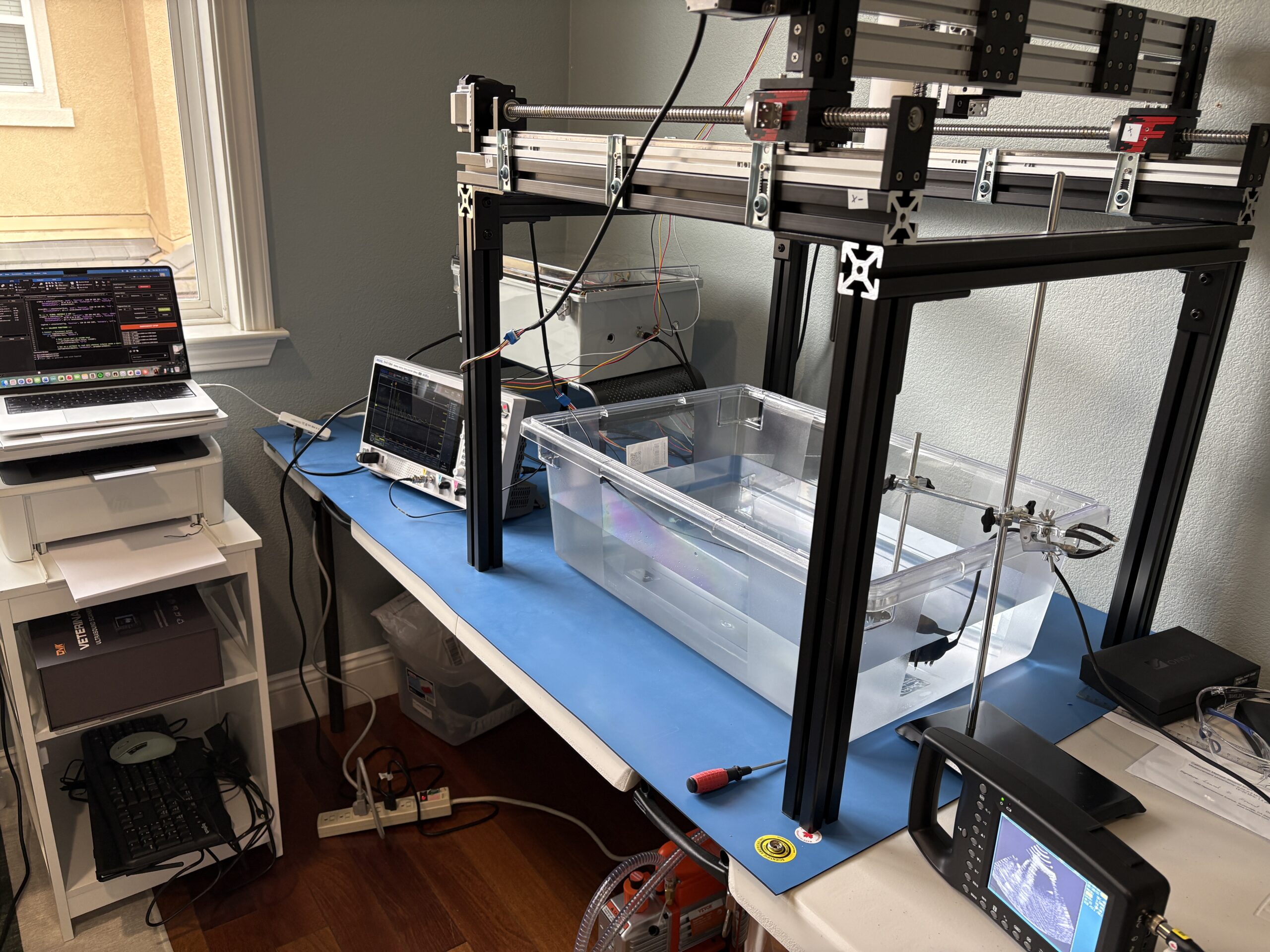
MATLAB is used to collect and process data for ultrasound measurements. (Image courtesy of Bay Area Sonic Solutions)
“In most ultrasound labs, MATLAB is the tool people learn first,” Pawashe describes. “The signal processing, image processing, visualization, and simulation tools are all there.”
MATLAB sits at the core of her measurement and analysis workflow. Raw electrical signals captured by hydrophones are transformed using calibration data to reconstruct acoustic pressure waveforms. From there, parameters such as peak pressures, integrals, and spatial field maps that describe how sound propagates through space are calculated. Once the measurement system is properly aligned, MATLAB enables repeatable signal processing and visualization, helping turn raw data into insight.
“As a solo founder, I wanted a tool [MATLAB] I already trusted and one that has strong support behind it.” – Leela Pawashe, Founder at Bay Area Sonic Solutions.
A Founder Perspective Grounded in Values
Starting her own company was a deliberate decision for Pawashe. After years in high-growth environments, she wanted to work on problems she cared about while building something more sustainable.
Her guiding principles are simple. Every problem has a solution, and people matter. She brings that mindset to every engagement, recognizing the effort it takes for teams to reach the point where they ask for help and meeting them with respect and curiosity.
Looking Ahead
Bay Area Sonic Solutions is launching its services to give more teams access to early ultrasound characterization without the burden of building their own labs. “I’m excited to give people the feedback they need earlier, so they can make the best devices they can,” Pawashe concludes. “That is what this is all about.”
For Leela Pawashe, measurement is not just about data. It is about helping teams learn faster, reduce risk, and move forward with confidence.
Learn more about Bay Area Sonic Solutions: https://www.bayareasonicsolutions.com
Learn more about MathWorks Startup Program: https://www.mathworks.com/products/startups.html
- カテゴリ:
- Startup Spotlights




コメント
コメントを残すには、ここ をクリックして MathWorks アカウントにサインインするか新しい MathWorks アカウントを作成します。