
Beyond Tools: Building the Skills Engineers Need for AI-Enabled Digital Engineering

Why do some digital engineering initiatives scale while others stall? The difference is often not technology, but workforce capability. Our survey of aerospace and defense engineers found that many teams are expected to adopt digital engineering practices while still building expertise in system-level modeling, digital twins, digital thread, requirements traceability, simulation, code generation, and AI-enabled workflows. As agentic AI becomes part of engineering work, those skills become even more important because AI outputs must be traceable, testable, reviewable, and governed. Organizations that treat upskilling as a core part of their digital engineering strategy are better positioned to move from pilots to scalable adoption, shorten development cycles, and bring validated systems to market and the field sooner.
If digital engineering is a priority across aerospace and defense, why do so many initiatives still feel hard to scale?
One answer from our recent survey of 200 engineers in the aerospace and defense industry is pretty straightforward: teams are trying to transform engineering work while many engineers are still climbing the learning curve.
That may sound obvious, but it matters. Digital engineering is often discussed in terms of tools, architectures, digital twins, digital threads, automation, and AI. Those all matter. But the survey results point to something more practical: progress depends on whether engineering teams can build enough confidence with new workflows to use them in real programs.
In the survey, 49% of respondents said their primary relationship to digital engineering goals is identifying the best approaches and solutions to implement them. Another 27% said they are being asked to adopt or implement digital engineering elements as part of their work. At the same time, only 27% described themselves as very knowledgeable about digital engineering concepts and goals in aerospace and defense.
That gap is important because the work is already underway. Digital twins, digital thread, and upskilling were among the most active workstreams respondents identified. And when we asked what they wanted to learn, the answers were not vague. Engineers pointed to system-level architecture models for simulation, tradeoff analysis, and validation; integrated multi-domain digital twins; requirements traceability and validation in a digital thread; test and certification frameworks; code generation; SysML v2 model interoperability; legacy code integration; and DevOps workflows.
In other words, the next step is not just understanding digital engineering as a concept. It is learning how to make it useful in day-to-day engineering work.
Why is upskilling now on the critical path for digital engineering?
One thing we’ve discussed before is that digital transformation is a broad organizational effort, while digital engineering is much more specific. Digital engineering focuses on how engineering work gets done: how teams connect models, data, requirements, simulation, verification, and implementation across the lifecycle. That distinction matters because these survey results point to practical barriers for engineering workflows, not just transformation goals.
As organizations have put this transformation into practice, they are scaling connected digital engineering workflows faster than they are developing the skills needed to use them effectively. While leaders invest in platforms, infrastructure, standards, and pilots, workforce capability is often treated as a secondary concern.
Our survey suggests that this imbalance is becoming a barrier to progress. Learning was the largest near-term goal, with 45% of respondents seeking to deepen their understanding of digital transformation. A significant learning curve was the top hurdle to adopting new digital tools and processes, and training opportunities were the resource engineers most wanted from leadership.
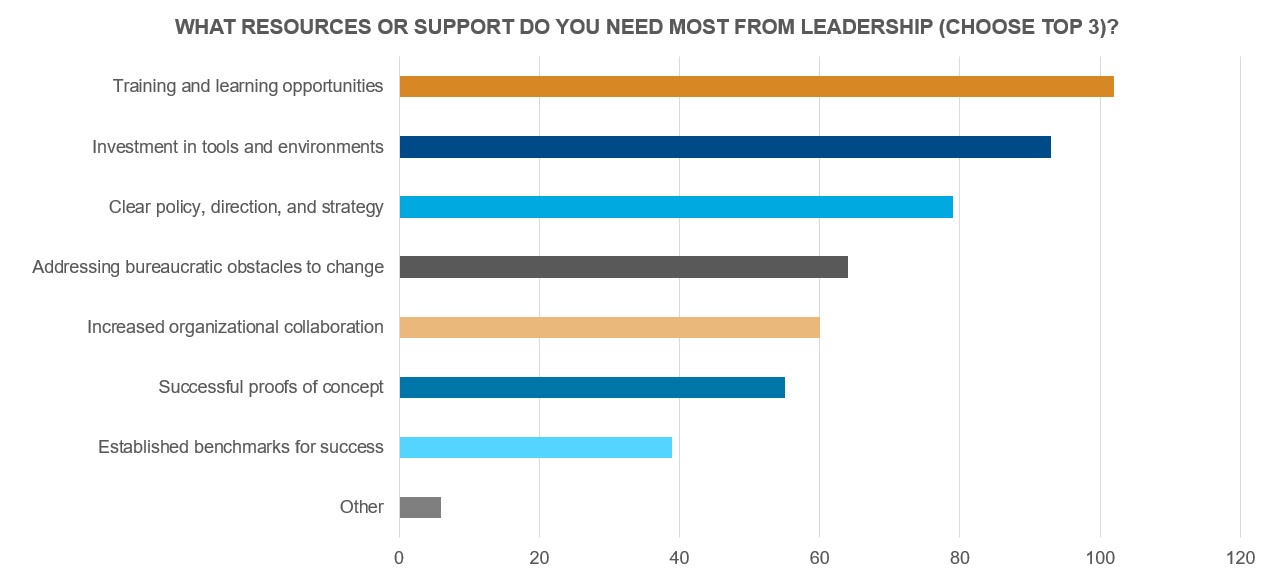
The message is clear: teams do not simply need more tools. They need a practical path to apply new methods in real engineering work.
Capability building is what turns digital engineering investments into scalable engineering practice. Teams need time and structure to connect new methods to real work. They need to understand where models fit, how artifacts connect, how simulation supports decisions, how requirements stay traceable, and how automated workflows can be trusted. Without that capability building, even strong initiatives around digital twin, digital thread, DevOps, and AI-enabled engineering can stall.
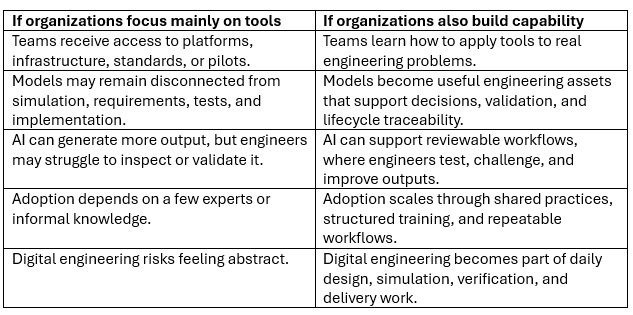
The timeline makes this more urgent. More than half of respondents with a defined timeline are working toward a digital engineering goal within the next 12 months, and nearly all respondents outside the “unsure” group are working toward a goal within 18 months. That makes upskilling more than a workforce development activity. It becomes part of the execution plan. For leaders, upskilling is no longer a support activity; it’s a delivery risk.
What digital engineering skills do engineers need most?
One of the more useful parts of the survey is that it points to the specific skills engineers are trying to build.
The strongest area of interest was using system-level architecture models for simulation, tradeoff analysis, and validation. That result says a lot. It suggests that teams are not just looking for better documentation of system architecture. They want models that can help them explore alternatives, validate behavior, and make decisions earlier in the lifecycle.
That distinction is central to digital engineering. A model that describes a system is useful. A model that can be connected to simulation, requirements, test results, and implementation decisions is much more powerful.
Respondents also showed strong interest in integrated multi-domain digital twins, requirements traceability and validation in a digital thread, test and certification frameworks, code generation, SysML v2 model interoperability, legacy code integration, and DevOps workflows. Taken together, these topics span the full engineering lifecycle: architecture, requirements, simulation, implementation, verification, certification, and deployment.
That is why upskilling cannot be limited to introductory awareness. Teams need practical learning paths that move from concept to application. They need to build models, run simulations, trace requirements, generate code, validate results, automate repeatable work, and understand how those activities fit together.
The goal is not to make every engineer an expert in every part of digital engineering. The goal is to give teams enough shared understanding and practical capability to make the workflow work.
When these capabilities work together, teams can explore designs earlier, validate requirements sooner, automate repeatable work, and reduce the late-state rework, helping compress the path from concept to deployment.
How does agentic AI change digital engineering skills needs?
Agentic AI adds another layer to this learning challenge.
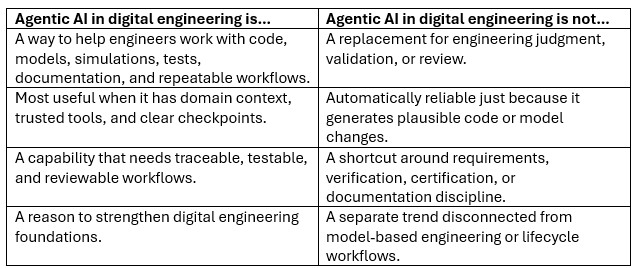
Engineering teams are already experimenting with AI assistants and agents. The opportunity is real, but it is not just about generating more output faster. In engineering, the more important question is whether AI can support work that is executable, testable, traceable, and reviewable.
That is where domain context matters. An AI agent that can suggest code or propose a model change is useful only if engineers can inspect what it did, test the result, connect it to the right artifacts, and decide whether it is valid. Digital engineering workflows already depend on that kind of discipline. AI makes it even more important.
For many teams, this will create a new skills gap. Engineers will need to understand how to use AI inside model-based workflows, simulation loops, testing processes, documentation practices, and review checkpoints. They will need to know when an AI-generated result is helpful, when it needs more context, and when it needs to be challenged.
This is also why agentic AI should be viewed as part of the broader digital engineering learning curve, not as a separate trend. If the foundation is weak – if models are disconnected, requirements are hard to trace, test evidence is manual, or workflows depend on tribal knowledge – AI can amplify the confusion. If the foundation is strong, AI has a better chance of helping teams move faster while keeping engineering judgment in the loop. Used effectively, agentic AI can accelerate model development, simulation, testing, code creation, and documentation, thereby reducing cycle time without bypassing engineering rigor.
How can leaders turn digital engineering training into practical capability?
The survey points to a practical takeaway for leaders: upskilling has to be treated like part of the digital engineering infrastructure.
That means giving teams structured ways to learn and apply new methods. It also means focusing training on the workflows engineers are actually trying to improve: system-level modeling, simulation, traceability, verification, automation, code generation, DevOps, and AI-enabled engineering.
The upskilling priority is not AI in isolation. It is AI applied to engineering tasks teams already need to perform. MathWorks training for agentic AI is designed with that practical goal in mind.
Accelerating Design and Analysis in MATLAB Using Agentic AI is a one-day private training that helps participants understand how agents operate, connect MATLAB with AI agents, use agentic AI to create MATLAB code and accelerate complex tasks, understand and extend large MATLAB code bases with AI assistance, and create custom skills for repeatable workflows.
Accelerating Engineering Design in Simulink Using Agentic AI is a one-day private training focused on how agentic AI systems use context, tools, and review loops to support Simulink engineering tasks. Participants work with the Simulink Agentic Toolkit to build, inspect, and edit models; complete engineering tasks with review checkpoints, simulation, testing, and documentation; and improve workflow consistency by incorporating domain knowledge through custom skills.
The important point is not just that these courses cover AI. They help engineers apply AI to work that must become faster, more repeatable, and more trustworthy so teams can complete iterations sooner, reduce manual effort, and move validated designs toward deployment faster.
What should organizations do next to scale digital engineering?
If there is one message to take from the survey, it is this: digital engineering is not limited only by ambition or technology. It is limited by how quickly teams can build, apply, and scale new skills.
That is a leadership issue as much as a technical one. Teams need access to tools, but they also need time to learn, opportunities to practice, support for moving away from legacy artifacts and processes, and workflows that make digital engineering feel usable rather than abstract.
Agentic AI makes this more urgent. As AI becomes part of engineering workflows, teams will need the skills to guide it, evaluate its outputs, connect it to trusted tools, and keep human review at the center of the process.
The opportunity is to turn the learning curve into an advantage. Organizations that invest in upskilling now can move faster, connect work more effectively, and give engineering teams the confidence to adopt digital engineering practices that scale.
How should leaders prioritize digital engineering upskilling?
Leaders can prioritize upskilling by asking five questions:
- Which workflows are under the most pressure? And creating the greatest delays?
Start with areas where teams are already trying to improve system-level modeling, simulation, traceability, verification, certification, code generation, DevOps, or AI-enabled engineering.
- Where is the knowledge gap slowing execution?
Prioritize teams that are responsible for adopting digital engineering but do not yet have deep confidence with the concepts, workflows, or tools.
- Which capabilities need hands-on practice, not just awareness?
Focus on skills that require application: building models, running simulations, tracing requirements, generating code, validating results, and automating repeatable work.
- Where will agentic AI require stronger review discipline?
Prioritize workflows where AI outputs must be inspected, tested, connected to artifacts, documented, and reviewed.
- What is the program timeline?
Treat upskilling as part of the execution plan when teams are working toward a digital engineering goal in the next 12 to 18 months.
Organizations that invest in digital engineering and agentic AI skills now can reduce rework, accelerate engineering decisions, and move trusted systems from concept to market and field faster.
Pragya Lakhotia is a leader in MathWorks Training Services, helping engineers and organizations build technical expertise and accelerate success with MATLAB and Simulink.


评论
要发表评论,请点击 此处 登录到您的 MathWorks 帐户或创建一个新帐户。