
From outputs to processes: My thoughts from SEFI 2026
The 54th SEFI Annual Conference brought more than 600 engineering educators to the Czech Technical University in Prague this September, under the theme “Engineering Education for Humanity in a Challenging World.” I came back with a better grasp of the problems our educator colleagues face, and with new collaboration opportunities to explore.
How do we protect the productive struggle that builds competence when a student can offload it to an LLM (e.g. creating materials, code, reports)? How do we teach which systems are worth building, not just how to build them? “How do we keep verification a real skill when the output almost always looks right?” What are the fundamental skills an engineer needs to have moving forwards? I don’t have clean answers… and frankly, I don’t think anyone does. Not yet. But many of us in the community are working on it!
So, here are three threads that stayed with me:
1. AI in teaching… but which AI, and for whom?
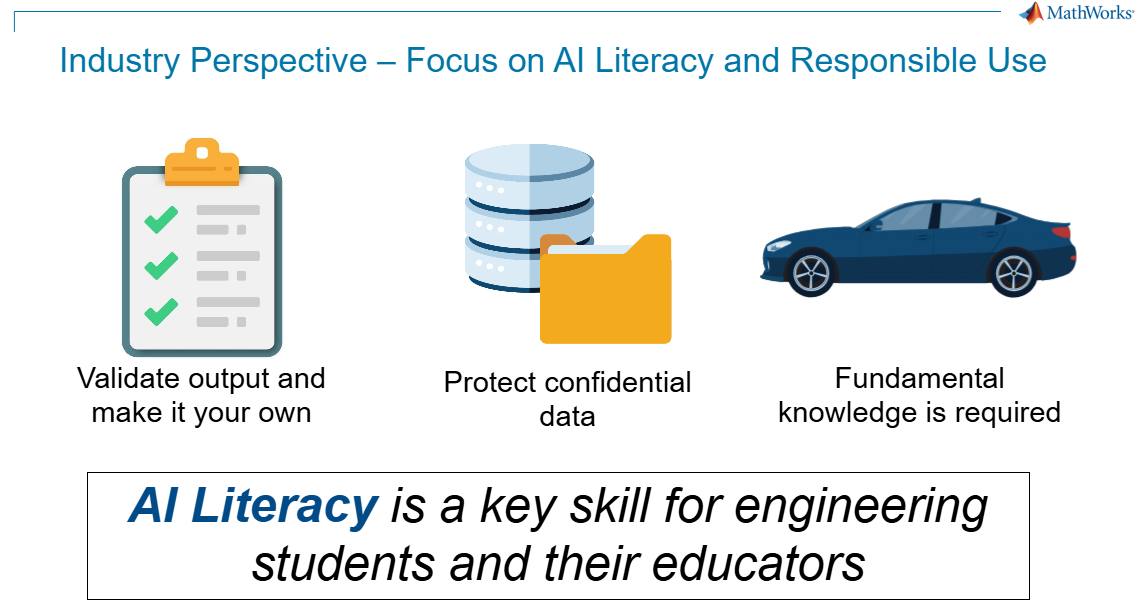
Unsurprisingly, AI was everywhere. I did notice a mismatch I don’t think the community has fully internalised yet: the way we talk about AI for teaching does not mirror the way practitioners actually use AI. That’s certainly true of my own work, and of the engineers I talk to across industry.
Model-Based Design together with agentic engineering are increasingly part of engineering practice in many fields, but they’ve barely crossed into how we talk about teaching and how we introduce these to students. To me, that gap between the AI in the practice sessions and the AI in the pedagogy sessions is the conversation worth having next.
Tanya Morton’s (MathWorks) demonstration of applied agentic workflows in Engineering practice resonated with the audience. Also, there was an audible gasp from 500+ people when she said “I reproduced a numerical experiment from my PhD in an afternoon”.
In the industry panel session the room was asked to name an idea that had inspired them, the answer looked like this:
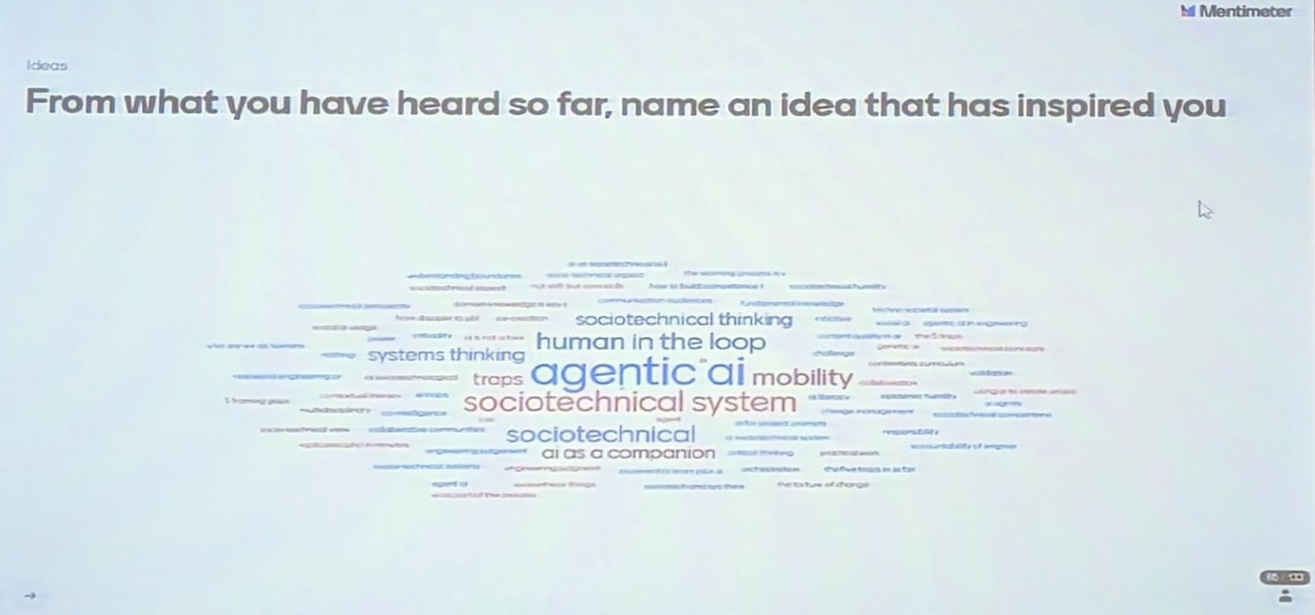
Conversely, AI misuse remains a problem for many academics. By misuse I’m trying to encapsulate ideas of academic integrity, cognitive offloading, over-reliance that erodes the fundamentals, and other failure modes. But if misuse exists, there is also “appropriate” use. The most compelling suggestions weren’t about clamping down; they were about raising the bar… designing challenges that push students further than LLMs can comfortably take them.
“The risk is not that engineers are replaced. The risk is that we hold on to the wrong parts of the role. Ultimately, our responsibility remains the same: Did we design the right system? And did we design the system right?”
Another framing that captured this well:
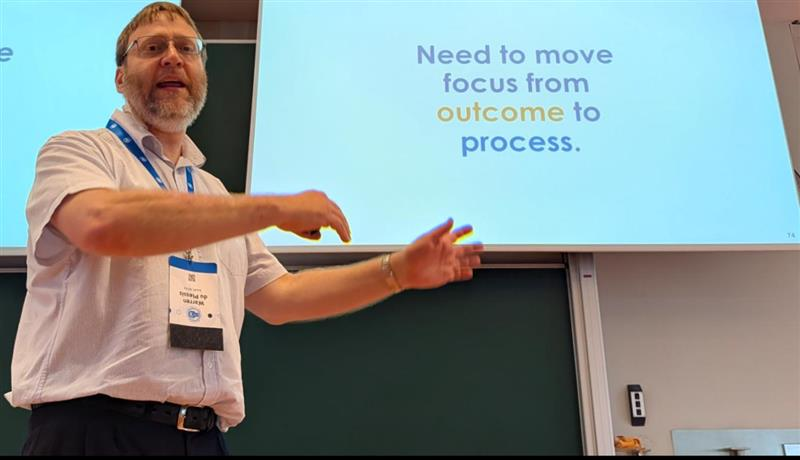
With AI in the loop, the final artifact is not a reliable proxy of understanding. As I have discussed before in EERN and other fora, artifact generation is now cheap. Assessing the thread that has led to such artifacts is perhaps a better proxy for understanding and engineering judgment. Shifting our attention from what students produce to how they got there is exactly what keeps them active participants rather than passive validators.
2. Industry engagement is having a moment
Industry–academia collaboration ran as a through-line across the programme, most visibly in the Continuing Engineering Education working group and in the workshop hosted by Rola Saad (UCL & University of Sheffield) & Pilar García Souto (UCL) , myself & Marco Rossi (MathWorks), and Bridget Ogwezi (Ansys).
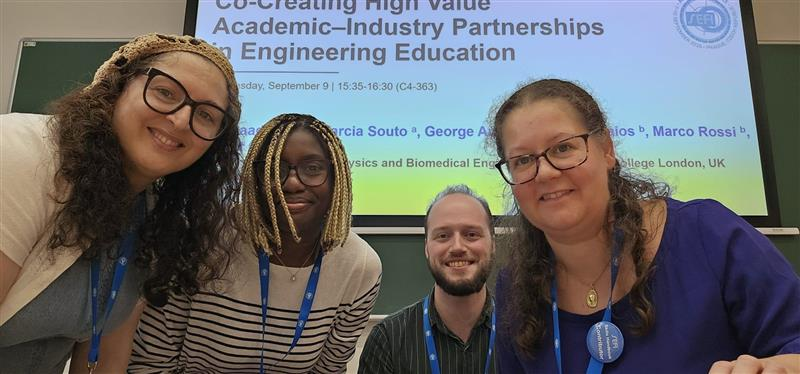
The workshop was a highlight. We explored “Co-Creating High Value Academic-Industry Partnerships in Engineering Education,”. We dug into the practical questions that usually get glossed over: what successful collaborations actually look like, what forms (modalities) they can take, what the real barriers are, and, most usefully, how to remove them. Personally, the prep was half the fun. We were up late on Sunday, ironing out the details. I felt like a student again!
A paper capturing the discussion is on the way, and I’d recommend keeping an eye out for it.
3. Project- and challenge-based learning
Tying the first two themes together, project-based and challenge-based learning were clearly where a lot of people’s thinking has landed. It’s not hard to see why. If the goal is to keep students in an active, creative role, and if industry relevance is the thing everyone wants to strengthen, then challenge-led approaches sit squarely at the intersection. Give students a hard, authentic problem, and some concerns start to take care of themselves.
A resource worth bookmarking: the SEFI Skills Handbook
One of the milestones of the week was the launch of the SEFI Handbook on Teaching Transferable Competencies and Skills in Engineering.
49 chapters, 155 contributors from 56 institutions and professional bodies across 23 countries and five continents, brought together by editors Gillian Saunders-Smits, Lynn Van den Broeck and Thies Johannsen. It’s organised into five parts spanning context and challenges, practical implementation, assessment, curriculum-level integration, and evaluation. It works both as a reference to dip into and as a practical manual to teach from.
Several chapters discuss project-based learning as the vehicle for developing transferable skills, which for me, is how we transition from assessing outputs to process
Wrapping up
If I had to compress SEFI 2026 into a single thread: the field is wrestling, productively, with how to keep the engineer central in engineering education.
One more thing: this was my first time at SEFI, and it was one of the most welcoming and insightful communities I’ve had the chance to be part of.
See you all next year in Sheffield!


댓글
댓글을 남기려면 링크 를 클릭하여 MathWorks 계정에 로그인하거나 계정을 새로 만드십시오.