
Accelerating Engineering Product Development with Agentic AI
Today’s guest writer is Rob O’Gara, Accelerator Program Lead at MathWorks.
Discover MathWorks Agentic AI Solutions on MathWorks.com
The era of agentic AI workflows has arrived and is here to stay. Each week, a growing number of startups across all industries are incorporating tools like Claude Code and Codex into their existing workflows. At the same time, investors are showing growing interest in startups that utilize agentic AI to improve their products and business models. Despite this momentum, there is not yet a clear, proven method for startups to use agentic AI when building technology based on an engineered system.
For engineering-focused startups, the lack of existing resources makes it significantly harder for them to adopt this new technology. Between tight deadlines and the need to build high-quality technologies, startups need clear ways to use agentic AI so they can move quickly with confidence. This post aims to address that need.
While there is not yet an established approach for applying agentic AI in engineering workflows, early use cases point to its potential. In combination with MATLAB and Simulink, teams are already using it to accelerate system-level modeling, testing, and simulation. These examples highlight where this approach can improve product development and provide a starting point for teams looking to adopt it.
Agentic AI in Practice: Use Cases with MATLAB and Simulink
To get the most out of agentic AI when building their engineering technologies, startups can pair their AI agent with MATLAB and Simulink to rapidly build digital twins of their technology as part of a model-based design workflow. By adopting this approach, startups will be able to quickly build strong digital prototypes of their technology before entering production. Specific opportunities to accelerate product development with agentic AI include:
Model Formulation
- Startups can prompt their AI agent to build an initial virtual model of an engineered product in MATLAB and Simulink, whether that is a drone, medical device, or battery system. To ensure the AI agent builds a strong model, startups will need to take the time to detail a specific prompt for the AI agent that specifies the project plan and requirements. The AI Agent then creates an initial model in MATLAB and Simulink based on the prompt. This is opposed to having engineers build the virtual model themselves, which can be time-consuming.
Unit Testing
- Similar to the model formulation approach, a startup can instruct an AI agent to simulate and test its product under different conditions. By prompting the AI agent to develop and run tests rather than doing it by hand, a startup will further speed up the development process, allowing engineers to focus more on analyzing test results rather than developing the tests themselves.
Debugging
- Using agentic AI with MATLAB and Simulink, startups can expedite the debugging process. Instead of manually searching for bugs, engineers can prompt their AI agent to identify and fix bugs in their models. When paired with a manual debugging process, this approach also increases an engineer’s confidence in the quality of the virtual model, as it has two ways to look for bugs.
Generating Internal Documentation
- As startups grow and more engineers join their team, they will need to have rich documentation of their past work to more easily capture and replicate their work. This is one area where agentic AI shines. By instructing the AI agent to review the session memory and capture the workflow, a startup can generate documentation in minutes rather than hours. This saves the engineering team time with strong, easy-to-understand documentation that can be shared internally.
A great example of this agentic AI-driven approach in the real-world can be seen in Lucid Motors’ presentation of their agentic AI workflows at the MathWorks Automotive Conference in April 2026.
Agentic AI, MATLAB, and Simulink: Accelerating Engineering Product Development
These examples highlight a clear finding: combining agentic AI with MATLAB and Simulink enables teams to build more quickly with greater confidence.
Startups can now direct AI agents to build and iterate on digital models more quickly than their engineering teams could on their own. With MATLAB and Simulink, those same workflows can extend into testing and debugging using mathematically grounded tools. As the technology continues to evolve, new opportunities are likely to emerge for improving how engineers build and validate complex systems with agentic AI.
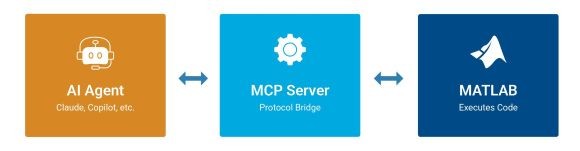
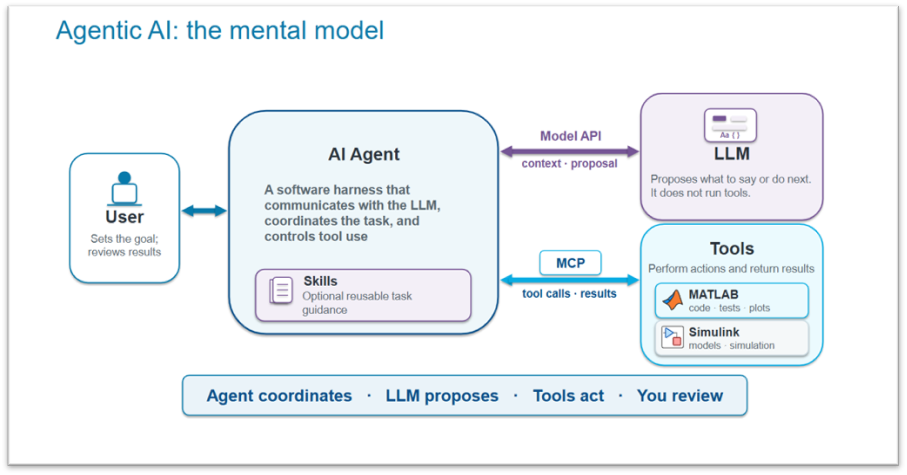
To support this shift, MathWorks released the MATLAB Agentic Toolkit and Simulink Agentic Toolkit, which connect AI agents with MATLAB and Simulink.
With these toolkits, MATLAB and Simulink can serve as a trusted, proven engineering layer alongside emerging AI workflows, helping teams maintain rigor as they move faster.
Through MathWorks Accelerator Program, startups at partnered accelerators and incubators can use MATLAB and Simulink at no cost for one year.




댓글
댓글을 남기려면 링크 를 클릭하여 MathWorks 계정에 로그인하거나 계정을 새로 만드십시오.