
Digital Engineering vs. Digital Transformation: A Conversation That Clarifies the Difference
“Isn’t digital engineering just another way of saying digital transformation?”
It’s a question we hear often and one that sounds reasonable on the surface. After all, both terms are used to describe how organizations modernize, adopt new tools, and rethink the way they work. But as we’ve discovered through countless conversations with customers and colleagues, treating these concepts as interchangeable can create confusion, unrealistic expectations, and stalled progress.
During a recent discussion with Jason, we unpacked where these ideas overlap and, more importantly, where they diverge.
Digital Transformation: The Big Umbrella
Kirsten:
When people talk about digital transformation, they’re usually talking about something very broad. It’s an organizational shift that touches everything, not just engineering. That includes how people are trained, how business workflows operate, how acquisition processes work in aerospace and defense, and how marketing or sales systems evolve.
Digital transformation is about how an organization operates.
Jason:
Exactly. I often think of digital transformation as an all-encompassing term. It’s not limited to building products, it’s about how the entire organization functions. For example, we’ve talked internally about the digital transformation of our marketing department: how leads are captured, how they’re processed, how systems talk to each other. That’s digital transformation, but it’s not digital engineering.
Digital transformation spans all business units. Digital engineering lives inside those focused-on building and sustaining products.
Digital Engineering: A Focused Discipline
Jason:
Digital engineering, for me, is a subset of that broader transformation. It’s relevant only to those teams or departments focused on designing, building, verifying, maintaining, or sustaining the engineered systems or products that define the company’s value. It’s about how engineering work is actually done.
Kirsten:
And that distinction matters. Digital engineering is not a project you complete and move on from. It’s a way of working. Once you adopt it, you’re doing digital engineering much like adopting Model‑Based Design. You don’t finish Model‑Based Design; you practice it.
Digital transformation, on the other hand, often implies an end state. There’s an idea that one day you’re “digitally transformed.” That framing doesn’t really fit digital engineering.
A Question of “Done”
Kirsten:
This is where the language starts to matter. Digital transformation sounds like something you finish like flipping a switch from “not transformed” to “transformed.” But digital engineering doesn’t work that way. It’s ongoing. It’s a state you strive to maintain and continuously improve.
Jason:
Right. You can transform a process to be digital, but digital engineering is how you continuously engineer. It’s not just digitalization. It’s a fundamentally different approach to engineering work.
Maturity, Not Checkboxes
Jason:
One helpful way to think about digital engineering is through maturity levels. You don’t jump straight to an ideal state. There are stages—how connected your data is, whether you have a true authoritative source of truth, how automated your processes are, how quickly you can perform impact analysis or trace changes across disciplines.
Kirsten:
And while these aren’t always formal metrics, there are observable outcomes. How much manual work remains? How early in the product lifecycle do you have verification and validation steps? How quickly can teams respond to change without introducing risk?
Those signals tell you whether you’re actually practicing digital engineering or just telling yourself you are.
The “Mountain Top” of Digital Engineering
Kirsten:
For me, the “mountain top” of digital engineering is when engineering artifacts are simulatable, verifiable, and automatable such that they can plug directly into pipelines like CI/CD. The more work that lives outside that system, the more waste exists in the engineering process.
Jason:
And that maturity really shows itself when something goes wrong.
Imagine a system in the field that starts failing under certain environmental conditions. Is it the sensor? The software? The mechanical design? With a mature digital engineering approach, you can quickly diagnose the root cause, understand the downstream impact, and determine the right fix—whether that’s a software update, a higher spec’d sensor, or a more fundamental redesign.
That ability to respond quickly and confidently is a powerful indicator of your digital engineering maturity.
A Litmus Test for Reality
Kirsten:
That scenario works almost like a thought‑experiment litmus test. If this happened in your organization today, how long would it take to diagnose the issue? To understand the impact? To deploy a fix safely?
Jason:
And that same kind of thinking can apply to digital transformation in other areas like marketing, sales, operations. The thread looks different, but the characteristics are similar: automation, traceability, time to respond, and confidence in outcomes.
Why the Distinction Matters
Kirsten:
When digital engineering and digital transformation are treated as the same thing, expectations get misaligned. Teams might think they’re “done” when they’re just getting started or underestimate the ongoing discipline required to truly modernize engineering.
Jason:
Seeing digital engineering as a focused, evolving practice within a broader digital transformation helps organizations invest more intentionally. It clarifies where engineering fits and what success actually looks like.
Final Thought
Digital transformation sets the stage for the organization.
Digital engineering defines how engineering business units perform on that stage every day.
Understanding the difference isn’t just semantics. It’s the foundation for building organizations that can adapt, respond, and innovate with confidence.
In the U.S. Aerospace & Defense industry, this distinction is especially consequential. The sector has been on a decades‑long digital transformation journey, with far‑reaching implications for how talent is recruited and developed, how programs are acquired and procured, how software is modernized, and most notably how engineering work itself is performed through digital engineering practices.
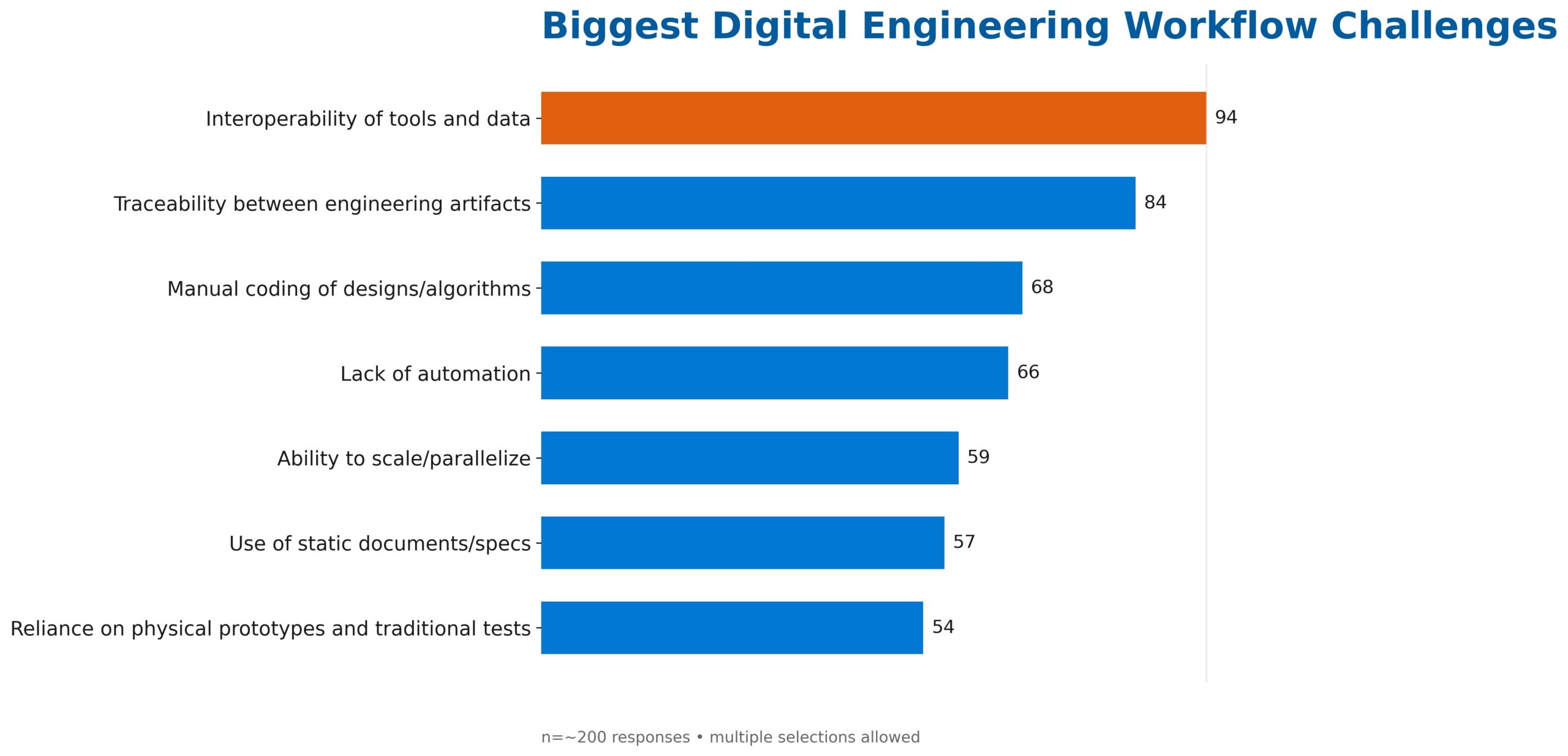
To better understand where organizations are focusing their efforts and where friction remains, MathWorks recently surveyed Aerospace & Defense engineers about their digital transformation priorities, challenges, and needs. The results were eye‑opening. In our next post, we’ll share insights from that survey and explore what they reveal about the current state and future direction of digital engineering in Aerospace & Defense.





Comments
To leave a comment, please click here to sign in to your MathWorks Account or create a new one.