
MathWorks Research Internship Experience: Divyamaan Sahoo
Today we’re talking to Divyamaan Sahoo, who participated in the Development Collaborative Research Grant program at MathWorks, which supports academic research aligned with development priorities for MATLAB and Simulink. Through the program, he contributed to the development of the Acoustic Library for Simscape, helping advance tools for modeling acoustic systems and transducers while supporting research and education in physical acoustics.
Meet Divyamaan Sahoo
My name is Divyamaan Sahoo and I am a puppeteer, sound artist, mathematician, and electroacoustic engineer. I am from Calcutta, West Bengal, India. I am currently pursuing my Ph.D. in Acoustics at The Pennsylvania State University in State College, PA. My area of study is physical acoustics, transducers and signal processing. I am interested in sound, acoustics and pure mathematics (number theory, geometry, and topology).

What’s your research about?
I am part of a team that is developing, testing, and documenting the Acoustic Library for Simscape, a foundational project that enables modeling acoustic phenomena using “lumped” elements. In broad terms, it is a method to break down a complex physical phenomenon into separate domains—electrical, mechanical, thermal, etc.—and describe the phenomenon in each domain using three elementary relationships: x is proportional to y, OR x is proportional to the derivative of y, OR x is proportional to the integral of y. The constants of proportionality here are denoted “R”, “L”, and “C” and x and y are defined such that their product x times y equals power. In the electrical domain, this describes the ubiquitous RLC circuit, where x is voltage and y is current. The fundamental idea here is that it is possible (and often beneficial) to define “R” “L” “C” elements in other physical domains. The reason is, instead of solving systems of (coupled) differential equations, one can draw analogous “R” “L” “C” circuits and evaluate the musing circuit analysis techniques. This is what Simscape achieves at its core.
Acoustic “R” “L” “C” circuits have been around for many decades and their inclusion in Simscape has been especially advantageous for studying and prototyping transducers .Dr. Stephen Thompson (my mentor and advisor) has been using these components to teach advanced transducer courses at Penn State with great success.
A simple example of how this is useful in a real-world application is the modeling of loudspeakers to determine the design and dimensions of their enclosures. Currently, the library highlights microphones, loudspeakers, and examples such as the multidomain modeling of earbud headphones inserted in a human ear. However, any physical acoustics problem using lumped elements can be modeled using this library. I anticipate that such a tool will have a tremendous impact on both industrial and educational contexts worldwide.
For someone who remains deeply curious about the art and science of transducers, it has been an especially rewarding experience to contribute to the Simscape Acoustic Library and have MathWorks support its development through the Development Collaborative Research Grant (DCRG) program. The library we see today is the result of Dr. Thompson’s research (and his advisor’s!) and is made possible thanks to cohorts of acoustics graduate students and faculty members at Penn State who have been using and refining these blocks over the years.
The Research Internship Experience
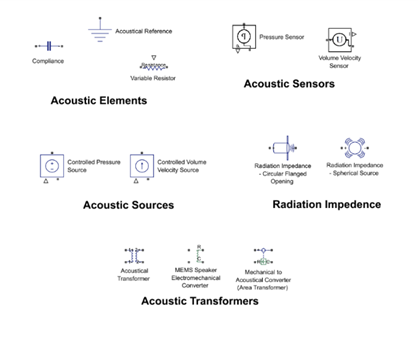
The primary goal of my internship has been to collaborate with Signal Processing & Communications (Audio Toolbox™ team) and Control Design Automation to build a support package for the Acoustic Library for Simscape by creating documentation for all components, maintaining equivalent analogous circuits of all blocks, conducting preliminary unit testing, developing Simscape code to specified conventions, and devising a unique set of icons for the library.
So far I have established a solid theoretical foundation for the library and internal design documentation for each component, redesigned icons for all components, maintained an exhaustive list of all equivalent circuits for each block in the library, and delivered a series of three in-depth lectures providing an overview and background to the Acoustic Library, distilling the concepts necessary to model acoustic systems using Simscape. I also conducted preliminary unit tests, identified bugs, and maintained a faithful record of meetings with various team members and stakeholders to ensure a smooth development workflow.
The result has been an in-depth and comprehensive literature review of all canonical acoustics references, including numerous critical papers and unpublished texts on transducers to ensure that the underlying physics of each component and their analogous circuit representations are accurate. This internship has been instrumental in strengthening the foundation of my Ph.D. research project on the R&D of novel transducers and signal processing algorithms for hearing aids.
What’s next?
Thanks to the encouragement of my team, I recently submitted an abstract to present our research at the upcoming Acoustical Society of America/ Acoustical Society of Japan conference this December, for the special session “Acoustics in Multiphysics Measurements: Modeling and Applications,” hosted by the Physical Acoustics Technical Committee. We hope that this abstract will be accepted!
I hope to continue working on the DCRG research project as part of my Ph.D. dissertation research in the Fall and contribute toward the success of the Acoustic Library release. It would be a dream to pursue a full-time role at MathWorks, focusing on R&D and technical writing for acoustics/audio.





コメント
コメントを残すには、ここ をクリックして MathWorks アカウントにサインインするか新しい MathWorks アカウントを作成します。