
From Real Roads to Real Simulations: How Team TwinX Won Smart India Hackathon 2025
The Smart India Hackathon (SIH) is a nationwide initiative aimed at engaging students in addressing some of the most pressing challenges of everyday life. Established to promote a culture of innovation and practical problem-solving, SIH serves as a dynamic platform for students to develop and showcase their creative solutions to real-world issues. Since 2019, MathWorks has partnered with SIH, guiding students through problem statements, webinars, and mentorship as they develop real world solutions.
Driving on Indian roads often demands constant alertness, what appears smooth and open can suddenly turn into a mix of potholes, unexpected barricades, roadside parking, and vehicles weaving in from every direction. Many traffic simulation tools, however, are built around orderly lanes and consistent driving patterns. Addressing the gap between these assumptions and real road conditions became the focus of Team TwinX’s work and shaped the solution that led to their win.
In this post, we are excited to feature Team TwinX from K.K Wagh Institute Of Engineering Education and Research, Nashik, the winners of the Smart India Hackathon (SIH) 2025 MathWorks problem statement. They share their journey, what they learned through the process, and how they approached the challenge.
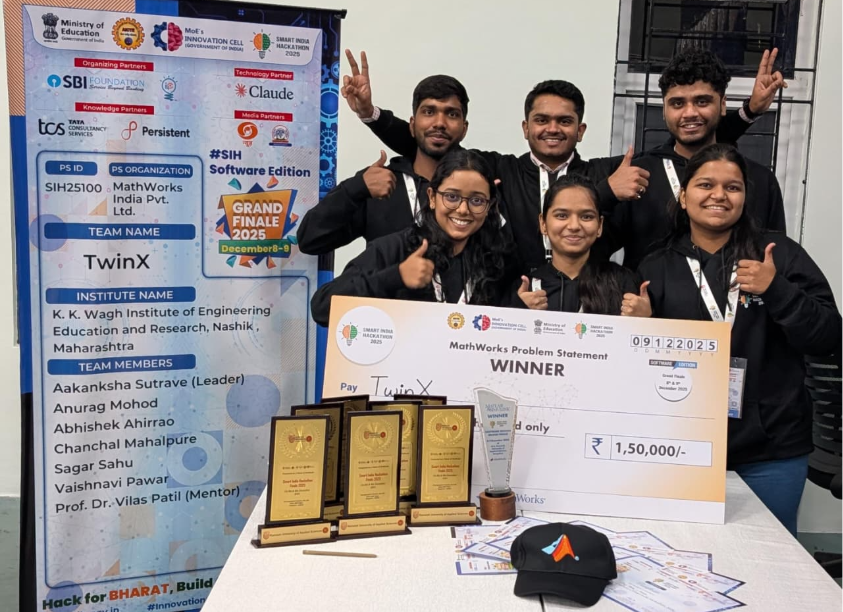
Team TwinX: Aakanksha Sutrave, Anurag Mohod, Abhishek Ahirrao, Vaishnavi Pawar, Sagar Sahu, Chanchal Mahalpure, Prof.Dr.Vilas Patil (Mentor).
The Challenge That Inspired Us
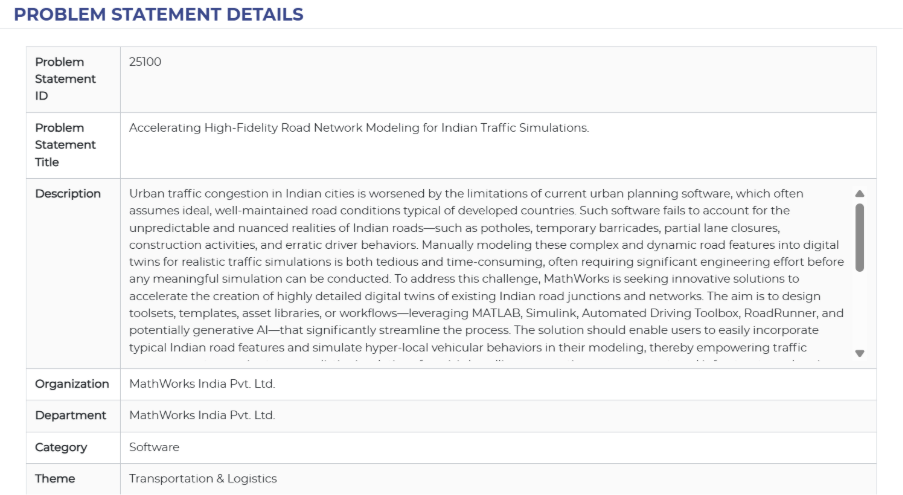
During the problem statement selection phase, we explored multiple options across domains. Instead of choosing something that sounded easy or familiar, we focused on problems that reflected real, visible challenges. When we came across the statement related to accelerating road network modelling for Indian traffic simulations, it immediately stood out because it aligned with everyday experiences and had strong real-world relevance. We chose this problem because it addressed a gap we could clearly observe. Indian roads are complex, dynamic, and unpredictable, yet most simulation tools are designed for ideal conditions. The problem allowed us to work at the intersection of technology, infrastructure, and real societal impact. More importantly, it offered room to innovate rather than simply implement a known solution.
Breaking down the Problem by ‘Design Thinking’ Approach
At first, the expectations felt high and the problem space broad, so our early discussions explored multiple directions before we identified what truly mattered. Once we broke the challenge into smaller components and defined the core problem, our ideas aligned and the solution began to take a clear, systematic form.
- Empathize: We observed that most traffic simulation tools are built for ideal roads, while Indian roads involve potholes, temporary barricades, mixed traffic, and unpredictable movement, making realistic modelling difficult for planners and researchers.
- Define: We identified that the core problem is not the lack of tools, but the heavy manual effort and absence of Indian-context awareness in existing road network modelling workflows.
- Ideate: We explored how real maps, simple text inputs, and automation could be combined to reduce effort while improving realism.
- Prototype & Test: We built and refined small functional modules, continuously checking whether the output truly reflected Indian road conditions and reduced user workload.
Preparation from Internal Hackathon to Winning the Grand Finale
August – September: The Beginning
From August to September, our journey started with the Team formation and internal rounds of the Smart India Hackathon on campus. This phase was less about having a perfect solution and more about forming the team having right learning mindset along with understanding the problem, exploring ideas, and most importantly, understanding each other as a team. We focused on building trust, identifying strengths, and seeing whether we could work together effectively when the solution itself was still unclear. The best thing we decided as a team was “Identifying and then playing on strength of each member”.
October: Finding the Right Direction
October marked a turning point when our idea was officially submitted on the SIH portal. The MathWorks problem statement pushed us to think beyond assumptions and focus on real Indian road conditions. This phase involved a lot of trial and error some ideas worked, others didn’t. But we keep working day and night on finding the right solution. All the late-night meetings pushed us to more clarity and practicality which mattered more than complexity. And by the end of the month, our solution had taken a clear and meaningful shape.
November: Validation and Refinement
Being selected as SIH 2025 grand finalists in November gave us confidence and a sense of responsibility. An expert working in same field was provided to us as a mentor for ‘mentoring session’ from ‘MathWorks’ as per SIH guidelines. This mentoring session help us to understand whether our approach was on the right track or not, while also pushing us to prepare for deeper scrutiny. This month was spent refining the concept, improving usability, and balancing technical depth. Every discussion helped us simplify and strengthen the solution.
December: The Grand Finale
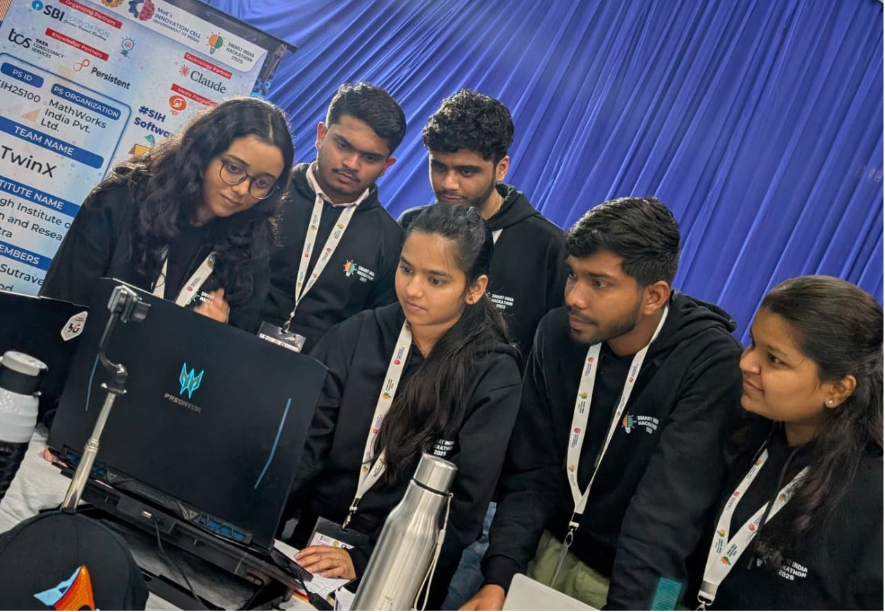
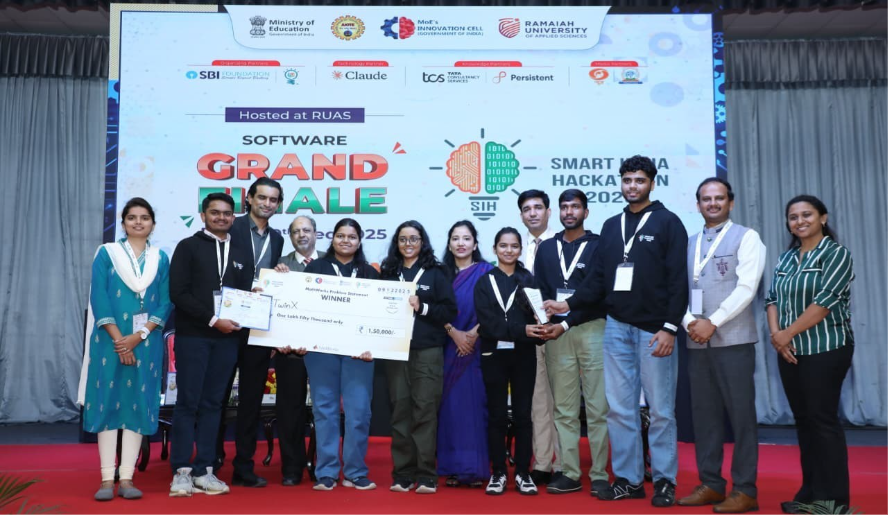
The grand finale on December 8-9 was intense and unforgettable. We followed a simple rule in each judging round “get feedback from judges in mentoring round and modify the solution till upcoming evaluation round”. Over 36 hours, despite exhaustion and pressure, we stayed focused and motivated to complete every task given by the judges. We worked for 34-35 hours in the 36 hours of hackathon. The pressure was high, but the environment pushed us to think clearly and communicate effectively. The journey from confusion to clarity felt complete at this stage. When we were announced as winners, it wasn’t just joy it was relief, gratitude, and pride in the months of learning, teamwork, and belief that brought us there.
Our Solution
Our solution is a software-based workflow that converts real-world Indian road data into complete, simulation-ready traffic scenarios with minimal manual effort. We start by importing real maps using OpenStreetMap or simple coordinate-based searches, which form the base of the road network.
On top of this, we automatically place vehicles and other pedestrians, assign realistic Indian driving behaviors, and allow users to modify distances and speeds through an easy-to-use interface. Scenarios can also be generated using plain text inputs, where AI-assisted logic helps create MATLAB-compatible scripts for traffic simulations.
To improve realism, we integrate Indian-specific road assets such as potholes, barricades, road damage, and construction elements. We also support creating 3D assets from 2D images and maintaining a reusable asset library for repeated use.
Weather conditions are added based on geographic location, allowing simulations to reflect real environmental conditions. Finally, the entire scenario can be exported directly to Driving Scenario Designer, RoadRunner, and Simulink for further editing, sensor integration, and high-fidelity 3D simulation.
Our approach significantly reduces manual modelling time while ensuring simulations reflect the actual complexity of Indian roads.
Why MATLAB Became the Backbone
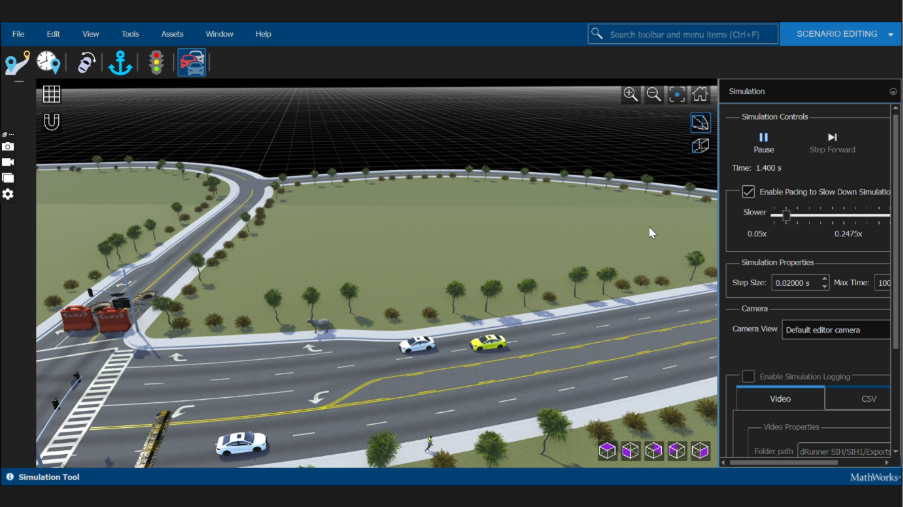
MATLAB was the backbone because it allowed us to build an end-to-end workflow on a single platform. Using MATLAB, we processed real map data, generated traffic scenarios, assigned driving behaviors, and directly connected the output to Driving Scenario Designer, RoadRunner, and Simulink.
Instead of switching between multiple tools, we automated the entire pipeline from OSM import and scenario logic to 3D simulation and weather integration within the MathWorks ecosystem. This made our solution technically consistent, easier to scale, and practical for real users such as traffic planners, researchers, and simulation engineers.
Lessons Learned During This Journey
A week before the SIH Grand Finale, We the Team TwinX sketched a handmade trophy and winning cheque not to predict the outcome, but to keep ourselves motivated and focused on taking one step at a time. As first-time participants, that belief, along with teamwork and consistency, turned SIH into more than a competition it became a lesson in clarity, coordination, and trusting the process.
Winning, for us, was never the starting goal, it naturally followed the lessons we gathered along the way. We learned that pivoting our ideas when needed, while staying committed to the larger objective, often leads to better outcomes. More than individual talent, it was collaboration that carried us forward. We also realized that steady, consistent effort sustains success far better than short bursts of intensity. In the end, the award marked a milestone, but it was the journey itself that truly shaped who we are as engineers.
- カテゴリ:
- Automotive,
- Hackathons




コメント
コメントを残すには、ここ をクリックして MathWorks アカウントにサインインするか新しい MathWorks アカウントを作成します。