bio_img_cleve

Posts 81 - 90 of 102

結果: People

Friedrich Bauer 5

Fritz Bauer, eminent German computer scientist and last surviving member of the organizing committee of the 1964 Gatlingburg Conference on Numerical Algebra, passed away on March 26 at the age of 90.... 続きを読む >>

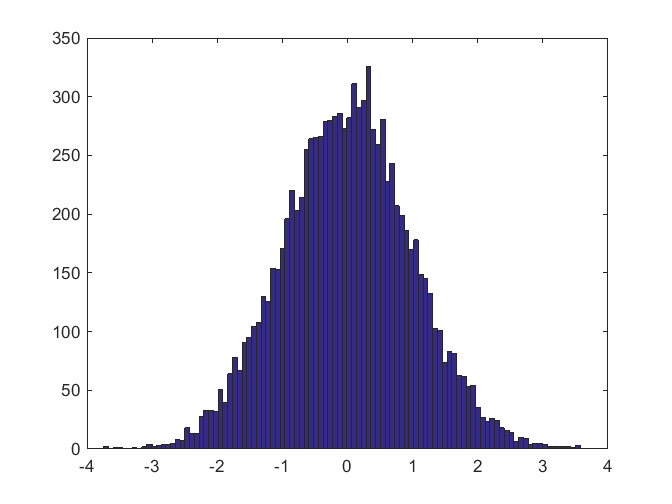
The Ziggurat Random Normal Generator

This is the third in a multi-part series on the MATLAB random number generators. MATLAB has used variants of George Marsaglia's ziggurat algorithm to generate normally distributed random numbers for almost twenty years. ... 続きを読む >>

Random Number Generators, Mersenne Twister

This is the first of a multi-part series about the MATLAB random number generators.... 続きを読む >>

An Ornamental Geometric Inequality 2

I came across this "ornamental geometric inequality" in a tribute to Lothar Collatz.... 続きを読む >>

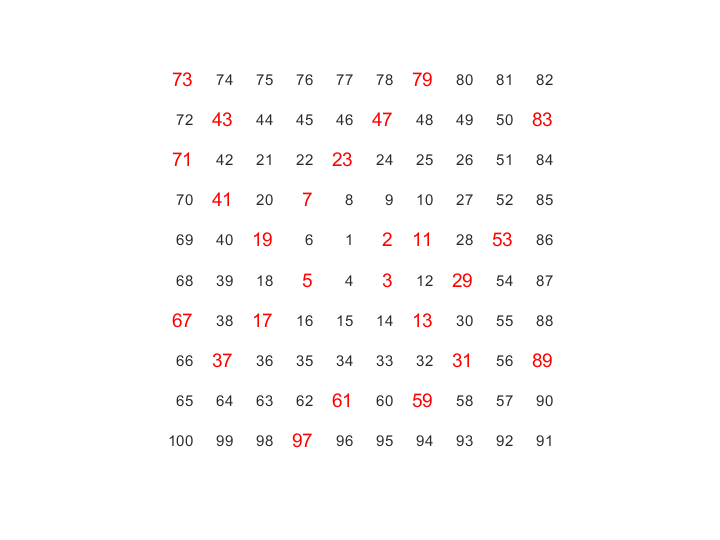
The Three n Plus One Conjecture 2

If $n$ is odd, replace $n$ by $3n+1$, if not, replace $n$ by $n/2$. Repeat. A famous conjecture made by Lothar Collatz is that no matter what value of $n$ is chosen to start, the process eventually terminates at $n=1$. Do not expect a proof, or a counterexample, in this blog. ... 続きを読む >>

Prime Spiral 2

The prime spiral was discovered by Stanislaw Ulam in 1963, and featured on the cover of Scientific American in March, 1964. ... 続きを読む >>

Jahnke and Emde, Revisited 1

An incredible book, published in several editions from 1909 to 1933, by German mathematicians Eugene Jahnke and Fritz Emde, contains definitions and formulas for mathematical functions, hand-calculated tables of function values, and meticulous hand-drawn 2- and 3-dimensional graphs. An English edition was published by Dover in 1945.... 続きを読む >>

Complete Pivoting and Hadamard Matrices 1

For several years we thought Hadamard matrices showed maximum element growth for Gaussian elimination with complete pivoting. We were wrong. ... 続きを読む >>

Floating Point Denormals, Insignificant But Controversial

Denormal floating point numbers and gradual underflow are an underappreciated feature of the IEEE floating point standard. Double precision denormals are so tiny that they are rarely numerically significant, but single precision denormals can be in the range where they affect some otherwise unremarkable computations. Historically, gradual underflow proved to be very controversial during the committee deliberations that developed the standard. ... 続きを読む >>

Floating Point Numbers 5

This is the first part of a two-part series about the single- and double precision floating point numbers that MATLAB uses for almost all of its arithmetic operations. (This post is adapted from section 1.7 of my book Numerical Computing with MATLAB, published by MathWorks and SIAM.) ... 続きを読む >>

Posts 81 - 90 of 102