
Matrix Condition and the QR Decomposition
The QR decomposition provides an estimate of the matrix condition number.
Contents
Query
Professor Magdy Hanna of the Department of Engineering Mathematics and Physics at Fayoum University in Fayoum, Egypt, asked me:
  If we have the QR decomposition of a matrix, with or without
  pivoting, is there an easy way to get the condition number of
  the matrix without starting from scratch and using the SVD?
Short answer
The short answer to Prof. Hanna's question is:
  Yes.  The ratio of the largest and smallest diagonal elements
  of qr(A) is often a good estimate of cond(A).
Compare this estimate to the exact condition of a magic square. Produce a score measuring how well the estimate does.
     A = magic(11);
     R = qr(A);
     d = abs(diag(R));
     est = max(d)/min(d);
     kappa = cond(A);
     disp("       est     kappa     score")
     disp([est kappa est/kappa])
       est     kappa     score
    2.6964   11.1021    0.2429
QR Decomposition
A more complete answer involves column pivoting.
The QR decomposition without column pivoting is an orthogonal Q and an upper triangular R so that
A = Q*R
The QR composition with column pivoting is an orthogonal Q, an upper triangular R and a permutation P that reorders the columns of A so that
A*P = Q*R
In either case, Q and P are orthogonal, so
cond(R) = cond(A)
Any estimate of the condition of R provides an estimate of the condition of A.
tricond
An estimate the condition of a triangular matrix is the ratio of the largest and smallest elements on the diagonal.
type tricond
     function cond = tricond(T)
        % Estimate condition of lower or upper triangular matrix.
        if istril(T) || istriu(T)
            D = diag(abs(T));
            cond = max(D)/min(D);
        else
            cond =  NaN;
        end
     end
qr function
Here is the 4-by-4 Pascal matrix
A = pascal(4)
A =

     1     1     1     1
     1     2     3     4
     1     3     6    10
     1     4    10    20
This matrix is reasonably well conditioned.
kappa = cond(A)
kappa =

  691.9374
With one output, the qr function provides the "Q-less" QR decomposition with no pivoting.
(With two outputs, the qr function produces the same R and also reveals the orthogonal Q.)
R = qr(A)
R =

   -2.0000   -5.0000  -10.0000  -17.5000
         0   -2.2361   -6.7082  -14.0872
         0         0    1.0000    3.5000
         0         0         0   -0.2236
For this matrix tricond without pivoting produces a poor estimate of the exact condition.
    trico = tricond(R);
    kappa = cond(A);
    disp("   tricond     kappa     score")
    disp([trico kappa trico/kappa])
   tricond     kappa     score
   10.0000  691.9374    0.0145
With three outputs, qr does column pivoting and returns a different R.
    [Q,R,P] = qr(A);
    R
R =

  -22.7376   -5.2336   -1.5393  -12.0065
         0   -1.6153   -1.2034   -1.3387
         0         0    0.4270   -0.2170
         0         0         0   -0.0638
Compare tricond and the exact condition.
    trico = tricond(R);
    disp("   tricond     kappa     score")
    disp([trico kappa trico/kappa])
   tricond     kappa     score
  356.6259  691.9374    0.5154
Column pivoting produces a much better tricond estimate for this matrix.
Gallery
Let's do more tests using these matrices from the MATLAB Gallery.
    funs = ["moler", "parter", "binomial",  "chebspec", "cauchy",...
           "chebspec", "chebvand","circul", "frank", "ris"];
One of these Gallery matrices is the "moler" matrix, even though I didn't invent it. A precursor to the "moler" matrix is a badly conditioned upper triangular matrix with ones on the diagonal, minus ones above the diagonal and zeros below.
    n = 5;
    U = eye(n) - triu(ones(n),1)
U =

     1    -1    -1    -1    -1
     0     1    -1    -1    -1
     0     0     1    -1    -1
     0     0     0     1    -1
     0     0     0     0     1
The "moler" matrix is
M = U'*U
M =

     1    -1    -1    -1    -1
    -1     2     0     0     0
    -1     0     3     1     1
    -1     0     1     4     2
    -1     0     1     2     5
The "moler" matrix squares the condition of U. The condition of M grows like 4^n.
kappa = cond(M)
kappa =

  865.9801
The tricond score without column pivoting is very poor.
    R = qr(M);
    trico = tricond(R);
    disp("   tricond     kappa     score")
    disp([trico kappa trico/kappa])
   tricond     kappa     score
   20.7364  865.9801    0.0239
With pivoting the score is much better.
[~,R,~] = qr(M);
    trico = tricond(R);
    disp("   tricond     kappa     score")
    disp([trico kappa trico/kappa])
  tricond     kappa     score
  555.0198  865.9801    0.6409
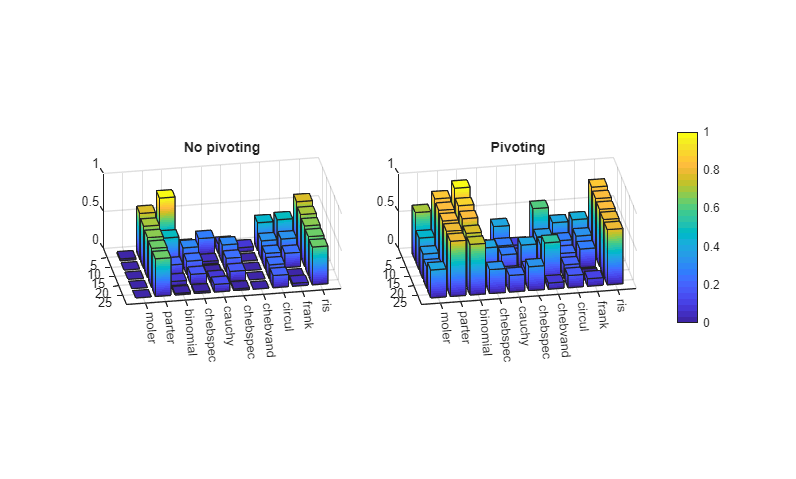
These scores are in the first line of the following output and in the upper left-hand corners of the 3-D bar graphs.
Tests
[Dnopiv,Dpiv,xt,yt] = tester(funs);
         fun     n    nopiv    piv


       moler     5    0.024    0.641
                10    0.000    0.426
                15    0.000    0.337
                20    0.000    0.287
                25    0.000    0.372

      parter     5    0.610    0.804
                10    0.564    0.776
                15    0.536    0.757
                20    0.517    0.744
                25    0.502    0.735

    binomial     5    0.795    0.926
                10    0.387    0.817
                15    0.150    0.768
                20    0.056    0.696
                25    0.021    0.674

    chebspec     5    0.120    0.110
                10    0.236    0.095
                15    0.183    0.358
                20    0.132    0.165
                25    0.022    0.318

      cauchy     5    0.217    0.376
                10    0.034    0.242
                15    0.016    0.247
                20    0.058    0.116
                25    0.102    0.222

    chebspec     5    0.120    0.110
                10    0.236    0.095
                15    0.183    0.358
                20    0.132    0.165
                25    0.022    0.318

    chebvand     5    0.055    0.577
                10    0.002    0.326
                15    0.000    0.338
                20    0.000    0.492
                25    0.000    0.082

      circul     5    0.370    0.370
                10    0.252    0.252
                15    0.209    0.209
                20    0.180    0.180
                25    0.162    0.162

       frank     5    0.390    0.390
                10    0.257    0.296
                15    0.191    0.248
                20      Inf    0.013
                25    0.039    0.100

         ris     5    0.610    0.804
                10    0.564    0.776
                15    0.536    0.757
                20    0.517    0.744
                25    0.502    0.735
Plot
[c,ax1,ax2] = ploter(funs,Dnopiv,Dpiv,xt,yt);


评论
要发表评论,请点击 此处 登录到您的 MathWorks 帐户或创建一个新帐户。