bio_img_cleve

Posts 81 - 90 of 169

Results for: History

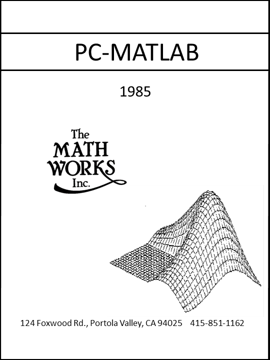
The Historic MATLAB Users’ Guide 5

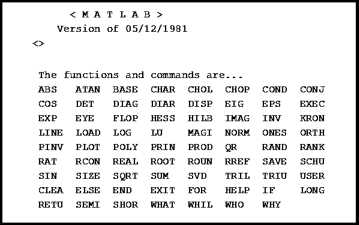
In the 1970s and early 1980s, while I was working on the LINPACK and EISPACK projects that I discussed in two previous posts, I was a Professor of Mathematics and then of Computer Science at the University of New Mexico in Albuquerque. I was teaching courses in Linear Algebra and Numerical Analysis. I wanted my students to have easy access to LINPACK and EISPACK without writing Fortran programs. By "easy access" I meant not going through the remote batch processing and the repeated edit-compile-link-load-execute process that was ordinarily required on the campus central mainframe computer.... read more >>

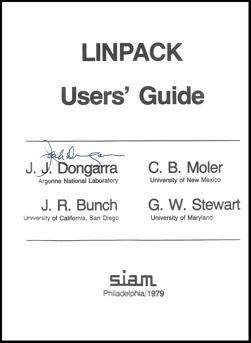
LINPACK, Linear Equation Package 2

The ACM Special Interest Group on Programming Languages, SIGPLAN, expects to hold the fourth in a series of conferences on the History of Programming Languages in 2020, see HOPL-IV. The first drafts of papers are to be submitted by August, 2018. That long lead time gives me the opportunity to write a detailed history of MATLAB. I plan to write the paper in sections, which I'll post in this blog as they are available. This is the third such installment.... read more >>

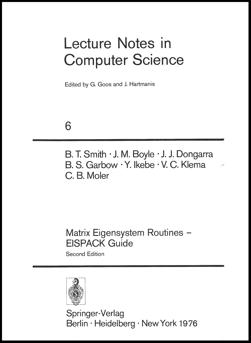
EISPACK, Matrix Eigensystem Routines

The ACM Special Interest Group on Programming Languages, SIGPLAN, expects to hold the fourth in a series of conferences on the History of Programming Languages in 2020, see HOPL-IV. The first drafts of papers are to be submitted by August, 2018. That long lead time gives me the opportunity to write a detailed history of MATLAB. I plan to write the paper in sections, which I'll post in this blog as they are available. This is the second such installment.... read more >>

Wilkinson and Reinsch Handbook on Linear Algebra

The ACM Special Interest Group on Programming Languages, SIGPLAN, expects to hold the fourth in a series of conferences on the History of Programming Languages in 2020, see HOPL-IV. The first drafts of papers are to be submitted by August, 2018. That long lead time gives me the opportunity to write a detailed history of MATLAB. I plan to write the paper in sections, which I'll post in this blog as they are available.... read more >>

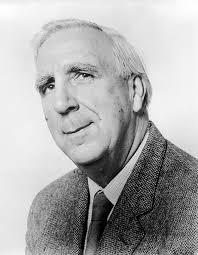
Leslie Fox

Leslie Fox (1918-1992) is a British numerical analyst who was a contemporary of three men who played such an important role in my education and early professional life, John Todd, George Forsythe, and Jim Wilkinson. Although I saw less of Fox than I did of the others, he was still an important influence in my life.... read more >>

Two Other MATLABs, in Bangladesh and in Hindi 2

This post is about the words "Matlab" and "matlab", in upper and lower case, and without a trademark symbol. Matlab with a capital "M" is a district in Bangladesh. "matlab" with a lower case "m" is a common word in the Hindi language. ... read more >>

My First Computer, the Burroughs 205 Datatron 1

The first computer that I seriously used was the Burroughs 205 Datatron. I actually used two different machines, one at Caltech for two years in 1959-61 and one at the University of Utah in the summer of 1960. Both the technology and the style of usage were wildly different from today's computers.... read more >>

Brad Efron’s Nontransitive Dice

Do not get involved in a bar bet with Brad Efron and his dice until you have read this.... read more >>

C^5, Cleve’s Corner Collection Card Catalog 2

I have been writing books, programs, newsletter columns and blogs since 1990. I have now collected all of this material into one repository. Cleve's Corner Collection consists of 458 "documents", all available on the internet. There are... read more >>

Levenshtein Edit Distance Between Strings

How can you measure the distance between two words? How can you find the closest match to a word in a list of words? The Levenshtein distance between two strings is the number of single character deletions, insertions, or substitutions required to transform one string into the other. This is also known as the edit distance.... read more >>

Posts 81 - 90 of 169