
Pi DayHappy Pi Day, 3/14.Here are 10,000 digits of π. Notice the six consecutive 9's in the sixth row, digits 763 through 768. n = 100; % Get pi from Symbolic Toolbox. p =... read more >>

Pi DayHappy Pi Day, 3/14.Here are 10,000 digits of π. Notice the six consecutive 9's in the sixth row, digits 763 through 768. n = 100; % Get pi from Symbolic Toolbox. p =... read more >>
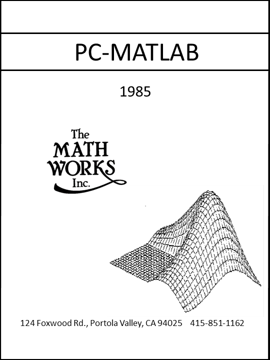
The ACM Special Interest Group on Programming Languages, SIGPLAN, expects to hold the fourth in a series of conferences on the History of Programming Languages in 2020, see HOPL-IV. The first drafts of papers are to be submitted by August, 2018. That long lead time gives me the opportunity to write a detailed history of MATLAB. I plan to write the paper in sections, which I'll post in this blog as they are available.... read more >>


ContentsThanks ezplot('(x^2+y^2-1)^3 = x^2*y^3', ... [-1.5,1.5,-1.2,1.5]) colormap([.5 .2 .2]) ThanksEdward Scheinerman, The Mathematics Lover's Companion, Yale University Press,... read more >>
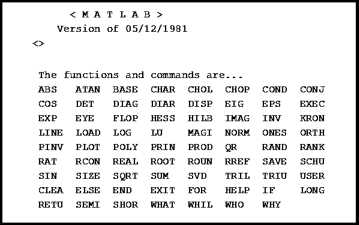
In the 1970s and early 1980s, while I was working on the LINPACK and EISPACK projects that I discussed in two previous posts, I was a Professor of Mathematics and then of Computer Science at the University of New Mexico in Albuquerque. I was teaching courses in Linear Algebra and Numerical Analysis. I wanted my students to have easy access to LINPACK and EISPACK without writing Fortran programs. By "easy access" I meant not going through the remote batch processing and the repeated edit-compile-link-load-execute process that was ordinarily required on the campus central mainframe computer.... read more >>
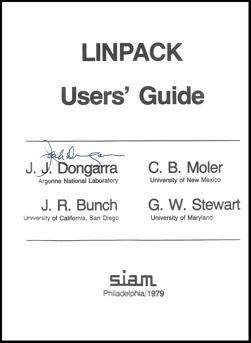
The ACM Special Interest Group on Programming Languages, SIGPLAN, expects to hold the fourth in a series of conferences on the History of Programming Languages in 2020, see HOPL-IV. The first drafts of papers are to be submitted by August, 2018. That long lead time gives me the opportunity to write a detailed history of MATLAB. I plan to write the paper in sections, which I'll post in this blog as they are available. This is the third such installment.... read more >>
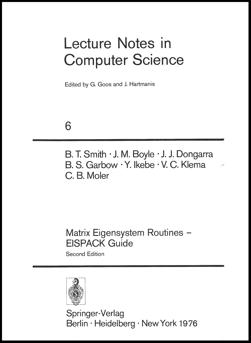
The ACM Special Interest Group on Programming Languages, SIGPLAN, expects to hold the fourth in a series of conferences on the History of Programming Languages in 2020, see HOPL-IV. The first drafts of papers are to be submitted by August, 2018. That long lead time gives me the opportunity to write a detailed history of MATLAB. I plan to write the paper in sections, which I'll post in this blog as they are available. This is the second such installment.... read more >>
My post on May 8 was about "half-precision" and "quarter-precision" arithmetic. I also added code for objects fp16 and fp8 to Cleve's Laboratory. A few days ago I heard from Pierre Blanchard and my good friend Nick Higham at the University of Manchester about a serious bug in the constructors for those objects.... read more >>

The ACM Special Interest Group on Programming Languages, SIGPLAN, expects to hold the fourth in a series of conferences on the History of Programming Languages in 2020, see HOPL-IV. The first drafts of papers are to be submitted by August, 2018. That long lead time gives me the opportunity to write a detailed history of MATLAB. I plan to write the paper in sections, which I'll post in this blog as they are available.... read more >>
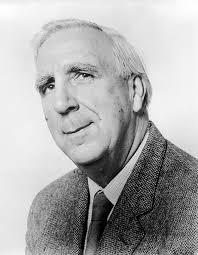
Leslie Fox (1918-1992) is a British numerical analyst who was a contemporary of three men who played such an important role in my education and early professional life, John Todd, George Forsythe, and Jim Wilkinson. Although I saw less of Fox than I did of the others, he was still an important influence in my life.... read more >>
These postings are the author's and don't necessarily represent the opinions of MathWorks.