File Exchange Pick of the Week

June 15th, 2007

Optimization tips and tricks

We spend a lot of time here at The MathWorks trying to figure out how to make it easier for people to get their mathematical “heavy lifting” done easier. Often times, that means finding ways of teaching people how to use MATLAB more effectively. John D’Errico, a prolific author here on the File Exchange, has put out a lot of high quality material. This week’s pick is one where he helps people learn how to do optimization in MATLAB.

This tips and tricks document is written for publishing (What is that?). There are many high quality examples in here. Thanks for all the work putting this together.
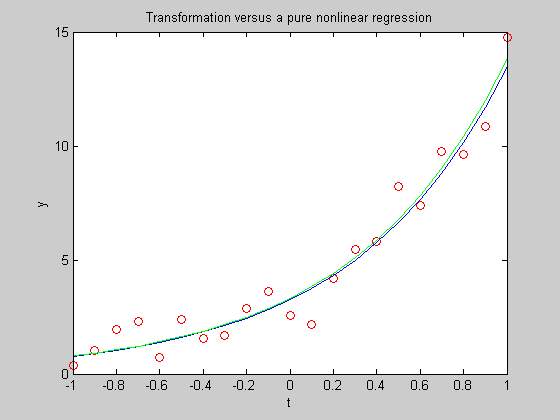
optimtips_13.JPG

9 Responses to “Optimization tips and tricks”

  1. Duane Hanselman replied on :

    John is an all-around top notch contributor to cssm, FEX, and the MATLAB wiki. To compensate him for his many continuing contributions, John should be able to get a MATLAB license just like book authors do. If you need justification, call this pick of the week a book. It is great!

  2. John D'Errico replied on :

    I spent many years at Eastman Kodak with my mentors and co-workers always being the editors of the top journals in statistics. It taught me that publication is a good way to make your work available to the world. Then Kodak moved into the mode of first asking whether any idea should instead be patented. So I earned a few patents in my name, but I never was happy with that idea.

    Once I retired, I realized that the file exchange on Matlab Central is really a publication tool for high quality software. Much like any journal, your work will be reviewed by your peers, but paper journals do the reviewing in advance of publication. The file exchange allows fully public peer reviews. Since you also have the ability to update and enhance your codes, those reviews help to provide world class codes.

    There are some truly top notch codes to be found on the file exchange, and I feel privileged to be able to contribute my own work to that mix.

  3. Colin replied on :

    I have to agree that john is one the top submitters and reviewers to the FEX!

    thanks for all your hard work!

  4. Marcuzzo replied on :

    Hello Hull!

    I have a problem to run my optimization code. Perhalps I don´t know the rights steps. I look the optimization toolbox but it doesn´t work. I´m trying to run one code of minimization cost of irrigation network with a lot of variables.
    Could you help me send me one code using the OPTIMTOOL for function objective (with a lot of variables) and another for constrains?

    Thansk a lot for your attention!

  5. Doug replied on :

    Marcuzzo,

    It is best for you to contact The MathWorks technical support directly:

    http://www.mathworks.com/support

    Thanks,
    Doug

  6. Pranitha replied on :

    Hi,

    I am using fmincon routine to find 8 unknowns with 2 equations. The unknowns should be in the domain [0,1]. That is the only contraint. Even though I give feasible start point that satisfies the equations and contraints, the optimization display says infeasible start point. Most of the times even though it says infeasible start point it performs the iterations and converges. What does this mean?

    Thank you,
    Pranitha

  7. Doug replied on :

    Pranitha,

    Please send your code to tech support, we can help figure it out.

    Doug

  8. Pranitha replied on :

    Can I just email the code to you, or is there an email ID (tech support) for these kind of issues.

    Thanks,
    Pranitha

  9. Doug replied on :

    Pranitha,

    http://www.mathworks.com/support

    Doug

Leave a Reply

Wrap code fragments inside <pre> tags, like this:

<pre class="code">
a = magic(3);
sum(a)
</pre>

If you have a "<" character in your code, either follow it with a space or replace it with "&lt;" (including the semicolon).


MathWorks

Brett & Jiro share their favorite user-contributed submissions from the File Exchange.

These postings are the author's and don't necessarily represent the opinions of The MathWorks.
