
A new app employs transformations of a graphic depicting a house to demonstrate matrix multiplication.... read more >>

A new app employs transformations of a graphic depicting a house to demonstrate matrix multiplication.... read more >>

MATLAB Central is celebrating its 15th birthday this fall. In honor of the occasion, MathWorks bloggers are reminiscing about their first involvement with the Web site. My first contribution to the File Exchange was not MATLAB software, but rather a collection of documents that I called the Pentium Papers. I saved this material in November and December of 1994 when I was deeply involved in the Intel Pentium Floating Point Division Affair…. read more >>

Jim Sanderson has had a fascinating professional life. He was my PhD student in math at the University of New Mexico in the 1970s. He spent almost 20 years as a computational scientist at Los Alamos National Laboratory, working on the lab’s supercomputers. He then developed an interest in ecology, went back to school, and is now the world’s leading authority on the preservation of small wild cats around the world…. read more >>


A few days ago we received email from Mike Hennessey, a mechanical engineering professor at the University of St. Thomas in St. Paul, Minnesota. He has been reading my book “Numerical Computing with MATLAB” very carefully. Chapter 7 is about “Eigenvalues and Singular Values” and section 10.3 is about one of my all-time favorite MATLAB demos, eigshow. Mike discovered an error in my description of the svd option of eigshow that has gone unnoticed in the over ten years that the book has been available from both the MathWorks web site and SIAM…. read more >>
Classical Gram-Schmidt and Modified Gram-Schmidt are two algorithms for orthogonalizing a set of vectors. Householder elementary reflectors can be used for the same task. The three algorithms have very different roundoff error properties…. read more >>

At a minisymposium honoring Charlie Van Loan this week during the SIAM Annual Meeting, I will describe several dubious methods for computing the zeros of polynomials. One of the methods is the Graeffe Root-squaring method, which I will demonstrate using my favorite cubic, $x^3-2x-5$.... read more >>

During the SIAM Annual Meeting this summer in Boston there will be a special minisymposium Wednesday afternoon, July 13, honoring Charlie Van Loan, who is retiring at Cornell. (I use "at" because he's not leaving Ithaca.) I will give a talk titled "19 Dubious Way to Compute the Zeros of a Polynomial", following in the footsteps of the paper about the matrix exponential that Charlie and I wrote in 1978 and updated 25 years later. I really don't have 19 ways to compute polynomial zeros, but then I only have a half hour for my talk. Most of the methods have been described previously in this blog. Today's post is mostly about "roots".... read more >>
What does $\sqrt[12]{2}$ have to do with music? What are equal temperament and just intonation? How can the MATLAB function rats help tune a piano? (This post is based in part on the Music chapter in my online book, Experiments in MATLAB.)… read more >>

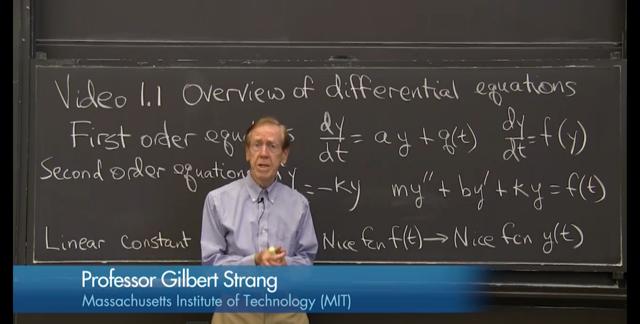
Gil Strang has produced a MOOC-style video course on Differential Equations and Linear Algebra. I have added some videos about the MATLAB ODE suite. The series is available from the MathWorks Web site, MIT OpenCourseWare and several other popular sources.... read more >>
These postings are the author's and don't necessarily represent the opinions of MathWorks.