
The adjacency matrix of a hypercube demonstrates the new MATLAB graph object.... 更多内容 >>

The adjacency matrix of a hypercube demonstrates the new MATLAB graph object.... 更多内容 >>
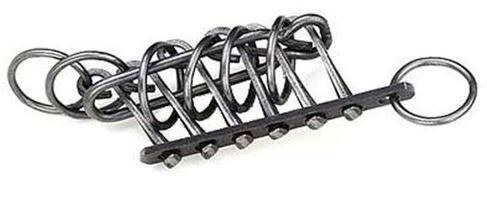
MIT's Professor Daniel Frey recently introduced me to an ancient mechanical puzzle known as "Chinese Rings", "Patience", or "Baguenaudier." I have modified Daniel's simulator to produce a new app. The state space of the puzzle forms a hypercube.... 更多内容 >>

"ULP" stands for "unit in the last place." An ulps plot samples a fundamental math function such as $\sin{x}$, or a more esoteric function like a Bessel function. The samples are compared with more accurate values obtained from a higher precision computation. A plot of the accuracy, measured in ulps, reveals valuable information about the underlying algorithms.... 更多内容 >>

A headline in the New York Times at the end of 2016 said "Growth of U.S. Population Is at Slowest Pace Since 1937". This prompted me to revisit an old chestnut about fitting and extrapolating census data. In the process I have added a couple of nonlinear fits, namely the logistic curve and the double exponential Gompertz model.... 更多内容 >>

I don't recall where I found this seasonal fractal. And I can't explain how it works. So please submit a comment if you can shed any light on either of these questions.... 更多内容 >>

When I was in high school in the 1950's, I didn't know anything about matrices. But I nearly encountered one when I wrote a paper for my physics class about the color scheme that allowed new color TV broadcasts to be compatible with existing black-and-white TV receivers.... 更多内容 >>

(Please replace the erroneous posting from yesterday, Nov. 28, with this corrected version.)... 更多内容 >>
Here is a very short course in Linear Algebra. The Singular Value Decomposition provides a natural basis for Gil Strang's Four Fundamental Subspaces.... 更多内容 >>

My favorite ordinary differential equation provides a good test of ODE solvers, both numeric and symbolic. It also provides a nice illustration of the underlying existence theory and error analysis.... 更多内容 >>
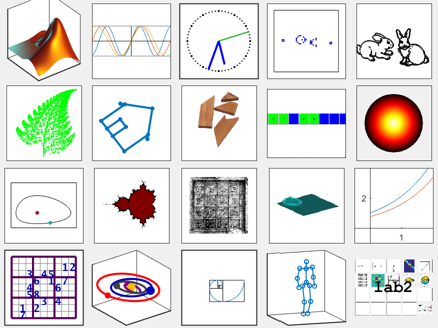
I am launching a project that I call Cleve's Laboratory. My most recent Cleve's Corner column in MathWorks News & Notes is about the project. The MATLAB app itself is available for download from the MATLAB Central File Exchange.... 更多内容 >>
这些文章由作者发布,不一定代表 MathWorks 的意见。
