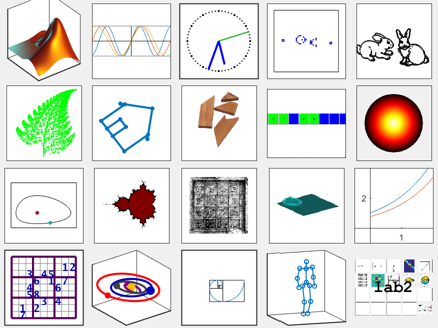
I am launching a project that I call Cleve's Laboratory. My most recent Cleve's Corner column in MathWorks News & Notes is about the project. The MATLAB app itself is available for download from the MATLAB Central File Exchange.... 更多内容 >>

I am launching a project that I call Cleve's Laboratory. My most recent Cleve's Corner column in MathWorks News & Notes is about the project. The MATLAB app itself is available for download from the MATLAB Central File Exchange.... 更多内容 >>

The QR decomposition is often the first step in algorithms for solving many different matrix problems, including linear systems, eigenvalues, and singular values. Householder reflections are the preferred tool for computing the QR decomposition.... 更多内容 >>

MATLAB Central is celebrating its 15th birthday this fall. In honor of the occasion, MathWorks bloggers are reminiscing about their first involvement with the Web site. My first contribution to the File Exchange was not MATLAB software, but rather a collection of documents that I called the Pentium Papers. I saved this material in November and December of 1994 when I was deeply involved in the Intel Pentium Floating Point Division Affair…. 更多内容 >>

Jim Sanderson has had a fascinating professional life. He was my PhD student in math at the University of New Mexico in the 1970s. He spent almost 20 years as a computational scientist at Los Alamos National Laboratory, working on the lab’s supercomputers. He then developed an interest in ecology, went back to school, and is now the world’s leading authority on the preservation of small wild cats around the world…. 更多内容 >>
Classical Gram-Schmidt and Modified Gram-Schmidt are two algorithms for orthogonalizing a set of vectors. Householder elementary reflectors can be used for the same task. The three algorithms have very different roundoff error properties…. 更多内容 >>

At a minisymposium honoring Charlie Van Loan this week during the SIAM Annual Meeting, I will describe several dubious methods for computing the zeros of polynomials. One of the methods is the Graeffe Root-squaring method, which I will demonstrate using my favorite cubic, $x^3-2x-5$.... 更多内容 >>

During the SIAM Annual Meeting this summer in Boston there will be a special minisymposium Wednesday afternoon, July 13, honoring Charlie Van Loan, who is retiring at Cornell. (I use "at" because he's not leaving Ithaca.) I will give a talk titled "19 Dubious Way to Compute the Zeros of a Polynomial", following in the footsteps of the paper about the matrix exponential that Charlie and I wrote in 1978 and updated 25 years later. I really don't have 19 ways to compute polynomial zeros, but then I only have a half hour for my talk. Most of the methods have been described previously in this blog. Today's post is mostly about "roots".... 更多内容 >>


The equations generating a surf plot of the Moebius strip can be parameterized and the parameters allowed to take on expanded values. The results are a family of surfaces that I have been displaying for as long as I have had computer graphics available.... 更多内容 >>

Recent theoretical, observational and computational results establish the possibility that gravitational waves produced by the dark energy created at the dawn of the universe affect the clock rate of silicon digital processors operating at very low temperatures.... 更多内容 >>